A Visit to the Berlin Porn Film Festival
Content note: discussions of sexuality, as well as mentions of sexual and political violence.
Last week I had the pleasure of attending Porn Film Festival Berlin, a five day film festival at arthouse cinemas across Berlin.
I attended this festival to see the premiere of "Mr. Bound & Gagged", a short documentary created and directed by my dear friend Carson Parish, which I worked on as a production manager and illustrated the credits. Though my role was primarily administrative (I made sure there were bagels in the morning and lunch at the ready), my heart had been with this documentary for many years ahead of its making.
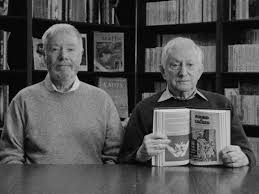
Carson and I met through the NYC scene a few years ago and have been creative friends ever since. Carson and I discussed our shared love of queer archives and belief in the importance of printed smut. It wasn't long before he told me had a longstanding friendship with Bob Wingate, the editor of a gay bondage magazine called "Bound & Gagged", an 80's and 90's publication I'd been collecting for years before I came to the city. I was spellbound.
At that time, I was starting to think more seriously about creating my own smut rag, which would later become Deviance Magazine. "Bound & Gagged" had been an important inspiration for me long before I'd met its makers. Not only was it filled with hot gay bondage porn, it included fantastic advice columns by sex theorist and trans writer Patrick Califia—in fact, I'd originally found the magazine by searching for discount vintage Califia writings on AbeBooks. B&G was stylish in a way that went beyond the other pubs of its era; it prized hot real-life stories and fiction, but harbored a proactively political flavor too. There were Q&As with kink-friendly doctors who gave actual medical recommendations for bondage practitioners, thoughtful notes about how BDSM could be a safer sex experience at the height of the AIDS crisis, and especially eloquent letters from the editor, Bob Wingate himself, which spoke to the political importance of freedom of sexual expression right alongside raunchy commentary on the endless joys of bound-up boys.
After dreaming about it for a year, Carson introduced me to Bob and his husband Lee, who'd also worked on the magazine. The two of them were sweet old gays who'd lived full lives of debauch. I felt right at home—and delightfully, we were all just about the same height (though I was the only trans man among us). Bob & Lee invited Carson and I over to their Upper West Side apartment for homemade bouillabaisse and aperol spritzes. Their living room was filled with paintings, books, and little sculptures in that lovely way of all old New Yorkers who've lived in the same apartment for decades. Then after dinner, we conducted an oral history of Bob & Lee's recollections of the magazine and the stories of their lives in and out of bondage. It was well past midnight when Carson finally stopped the recording. Story after story invigorated my deep desire to be a part of that publishing legacy myself.
When we were done, I asked Bob if he had any advice for me about starting up my own magazine. He told me about how the inaugural issues were mostly culled together from "New York Bondage Club" applications, a group he'd founded that pre-dated the magazine. He told me that people always have stories to share, and you don't ever have to look too far for exciting things to publish. Then he got up from the couch and went into the bedroom. When he returned, he held a thick caddy of yellowed xerox-style stapled zines. "This is 'Straight To Hell Magazine', edited by Boyd McDonald. This was my inspiration when I made 'Bound & Gagged', I thought it was just great," he said, reaching into the stack. He grabbed a bunch of magazines and handed half of them to me and the other half to Carson. "Here, you keep these. I don't know when I'm ever going to read them again."
It felt like I was holding gold. I read them all cover to cover, finding dirty stories far beyond the pale of anything getting published today. But I could see the throughline: everything in it was both viscerally hot and explicitly political. Boyd McDonald didn't waste a second lampooning Reagan's homicidal AIDS policy alongside stories of alleyway suck-and-fucks, just as Bob Wingate didn't blink twice when speaking against the atrocities of Abu Ghraib—and all from the platform of these porn magazines, which took so seriously the link between sexual freedom and collective liberation.
You can imagine my joy, then, when Carson reached out to me about creating a documentary film about the magazine. We hopped in the car to roadtrip to Chicago, where the Leather Archives & Museum houses all of the Bound & Gagged papers. There with a small crew, we filmed Bob & Lee's final visit to their archive, recording the history of the magazine as they reviewed letters, issues, and illustrations from periodicals past. Carson shot the whole thing on 16mm. As a print-publication diehard, I was enamored with his cross-media love of analog production.
As I've been with my husband in the UK, I couldn't make it to the New York premiere, so instead I went to Berlin—the perfect excuse to visit one of my best friends, a fellow deviant and wildly talented sculptor. We were excited to attend the Porn Film Festival, spending an hour on the phone poring over the programme and deciding which other screenings we wanted to see, settling on "Trans" and "Fetish" shortfilm series (all of which are still globally streamable til November 10th with a digital pass, including "Mr. Bound & Gagged" in the "Generations" shorts selection).
The final cut of the "Mr. Bound & Gagged" was heartfelt, cheeky, sexy, beautifully shot and deeply moving. I cried during it, honored to have been included as part of this history.
The other festival films were a range of genres and overall quite good. It was a lot of fun to be in a theater full of deviants getting to celebrate sexual media together, giving roses to creators who so often go underappreciated in an always-maligned genre. Most porn isn't very beautiful and is far more concerned with making money than anything else (which also explains why so much of it is white, straight, and usually violent in completely uninteresting ways). It was delightful to get to see a lot of films that cared about giving sexuality the creativity, production, and quality it deserves. However, after seeing these three screenings, I found myself a bit disappointed—not necessarily by the festival itself, but by what the festival's contents demonstrated about the wider culture of free sexual expression, or really, lack thereof.
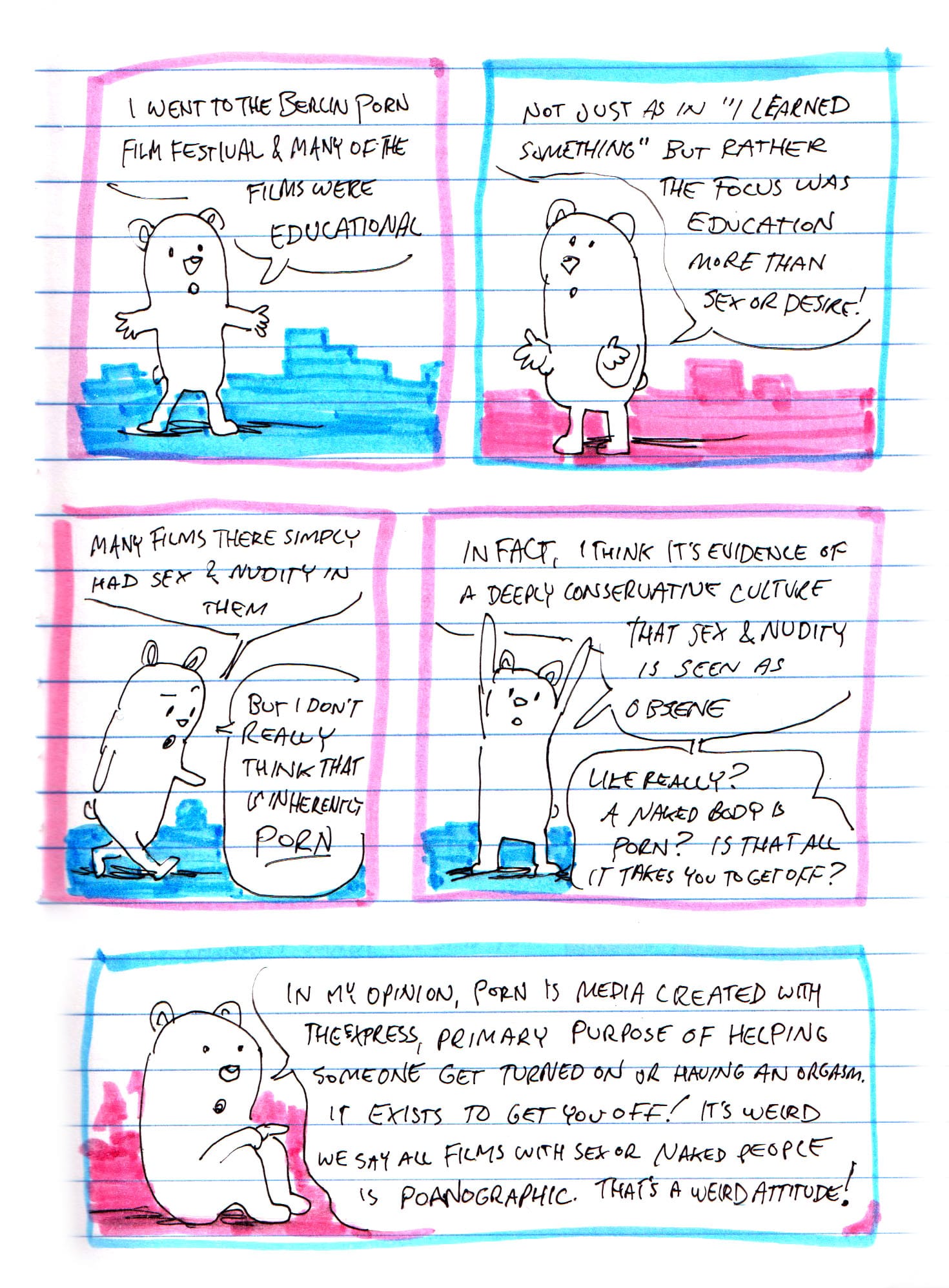
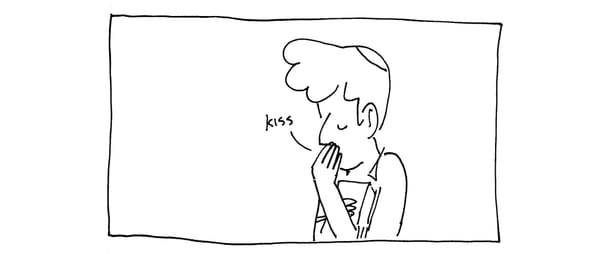
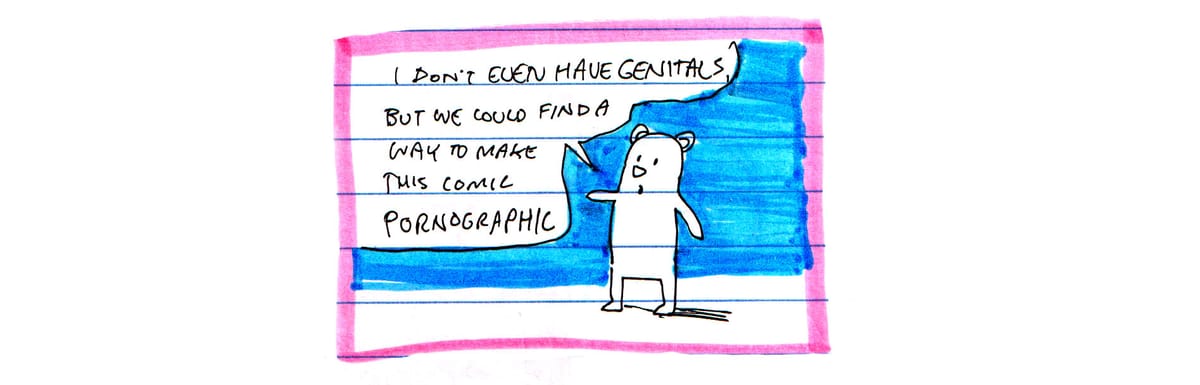
On the plane home I drew this little three-page comic in my composition book, surprised and delighted by the appearance of this little bear who I'd never drawn before; he just popped out of my hand to talk about porn. Both the bear and I were disappointed that so many of the films seemed to be "about" sex rather than being truly pornographic themselves.
As a smut magazine editor, I've come to feel strongly that what makes something pornographic is not the simple presence of sex, but rather a piece of media being created with the intention (or can reasonably used for the purpose) of getting off. Central to good porn is desire, creativity, and honesty. My favorite stuff is always extremely weird and specific, imbued with the anarchic, wild quality of make-believe games. Though all of the films we saw featured sex or nudity, many of them weren't porn, per my definition. And not just the documentaries.
A film about an eldery vampire displayed obscured sex behind frosted glass and its protagonist's nude body as she planned suicide-by-sunlight. A film about a trans woman's bottom surgery journey depicted her joyfully dancing and swimming alone in beautiful rock beach landscape. These films were certainly art, but they weren't porn. The Trans short films were mostly actually pornographic, but they often interrupted themselves to "educate" the audience about the actors' bodies, their safer sex practices, or heartfelt reflections about transition. I don't object to any of these things on their own, and I understand why in a sex-anxious culture this may have utility, but it reminded me once again that as trans people, we're never allowed to just be inside of our own desire without explaining it for the benefit of other trans people or for the curiosity of cis audiences. Combined with these less-than-mildly-horny other features, I was left feeling sad that nudity and sex are themselves considered prurient rather than just neutral facets of human life. Stories about sex can't be shown or featured in "polite" audiences, so instead their only home is crammed in at a Porn Film Festival, which is at best a miscategorization that limits our erotic imaginations and at worst, real evidence of an insidious cultural conservatism that conflates the human body with obscenity.
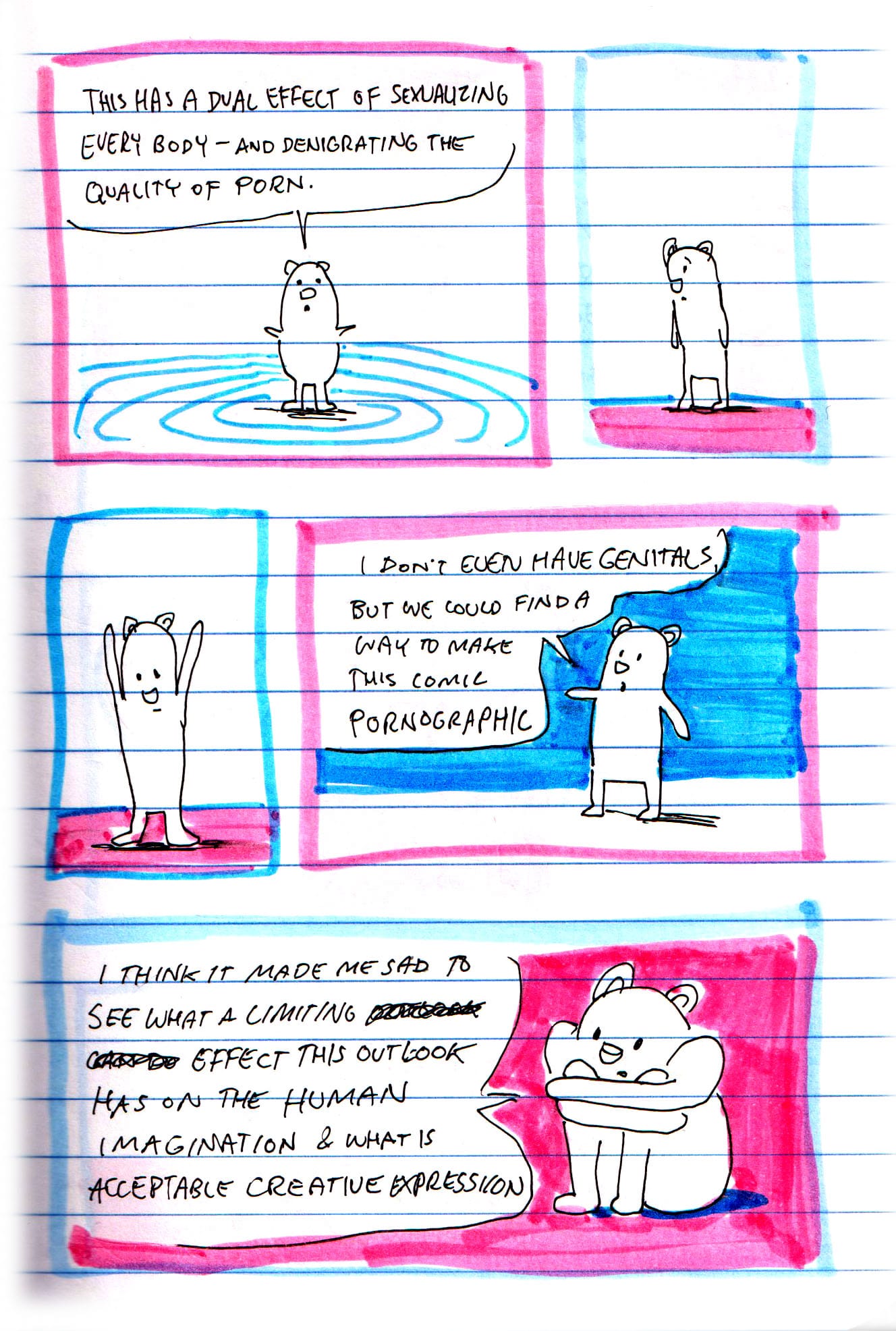
Though it's quite possible that this was mostly true of the three screening we attended but not other selections, I still think the critique stands. While the bear is frustrated by the way this logic limits sexual expression, I feel worried about the way it becomes a tool of political repression: When all bodies are inherently sexualized and sexuality is seen as obscene, dangerous, and immoral, we all lose. As a transsexual, I'm painfully aware of this.
The definition of pornography is hotly contested and highly political. Famously, U.S. Supreme Court Justice Potter Stewart said in his 1964 Order that he could not give a definition of what constituted pornography, but described it simply: “I know it when I see it.” Like art, pornography is categorically amorphous. What actually turns us on is totally idiosyncratic, which makes it hard to define. But while this "I know it when I see it" attitude is great for editing a smut publication, it's incredibly dangerous in the hands of repressive legal systems that want to eradicate sexual deviancy. Since fascists can't kill an idea, the next best thing is to kill the people who embody it.
Today, as Project 2025 takes root, we see new efforts to criminalize the existence of trans people through a logic that deems our bodies and lives intrinsically pornographic and therefore obscene. But sex isn't obscene, genocide and starvation are. Much of the legislation that decries "Gender Ideology" uses the language of obscenity to condemn anything that even alludes to the existence of trans people. As a porn magazine editor, however, it's very transparent to me that these legislators are also telling on themselves: the idea of gender non-conformity is so erotic to them, they see any mention of it as porn. But unlike healthy sexual deviants, their repression leads them to want to eradicate rather than enjoy whatever turns them on—and we all have to suffer for it.
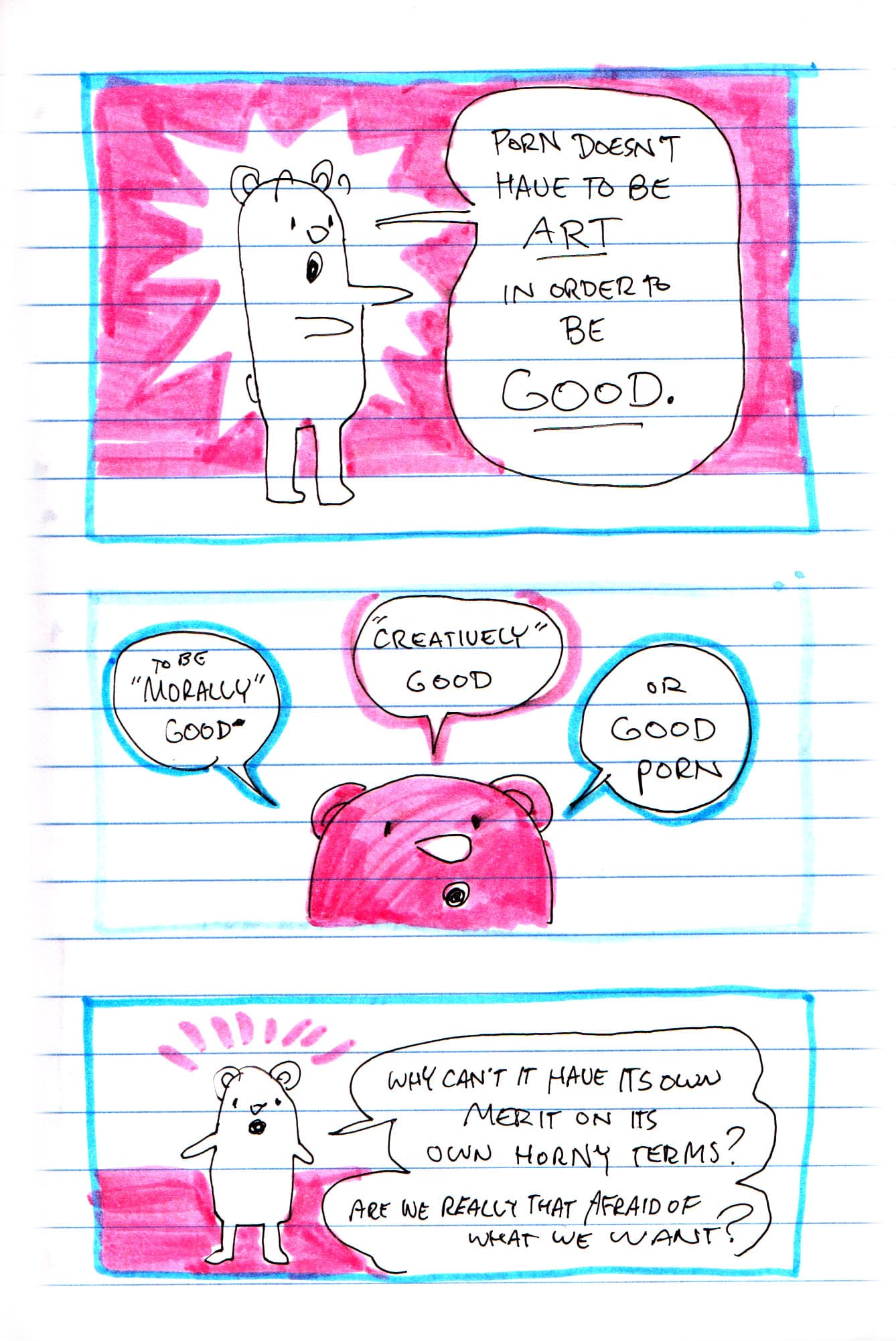
To answer our little bear: yes, we really are that afraid of what we want.
In Deviance Issue 3, my letter from the editor focused heavily on a uniquely American brand of delusion: the inability to distinguish fantasy from reality. Because so many people are terrorized into believing that having a sexual fantasy is the same as enacting it in reality, we live in a cultural hellscape in which thoughts are criminalized but genuine sexual harassment and assault, especially by straight white men, is totally banal. The two work in tandem as a backwards logic: We become confused about where the danger actually is—fantasizing (or making features for a Porn Film Festival) is seen as the source of violence, and this becomes the distraction for the fact that today's fascists use their personal sexual suppression to inform policies that coerce fertility and punish gender variation under the guise of protecting women and children. Repression begets violence, and the rest of us are constantly suffering for it.
My unending soapbox is for everyone to become less afraid of what they truly desire. G-d created the universe out of desire, from wanting it to be made. I deeply feel that desire is part of what makes us in the image of the divine, and theologically speaking, the vilification of porn and sex feels both cruel and genuinely godless. I often feel that sexuality is the canary in the coal mine for fascism. I don't just preach a politics of desire because it's personally liberating, but because it's also politically necessary. People who know who they are and what they want are less easily controlled. When we know what we want, we can figure out how to find it, make it, build it. We'll need those blueprints for an uncertain future. As Gramsci wrote, “The old world is dying, and the new world struggles to be born: now is the time of monsters.”
If now is the time of monsters, we're going to have to get freaky.