Cooking As Prayer: Food for Resistance
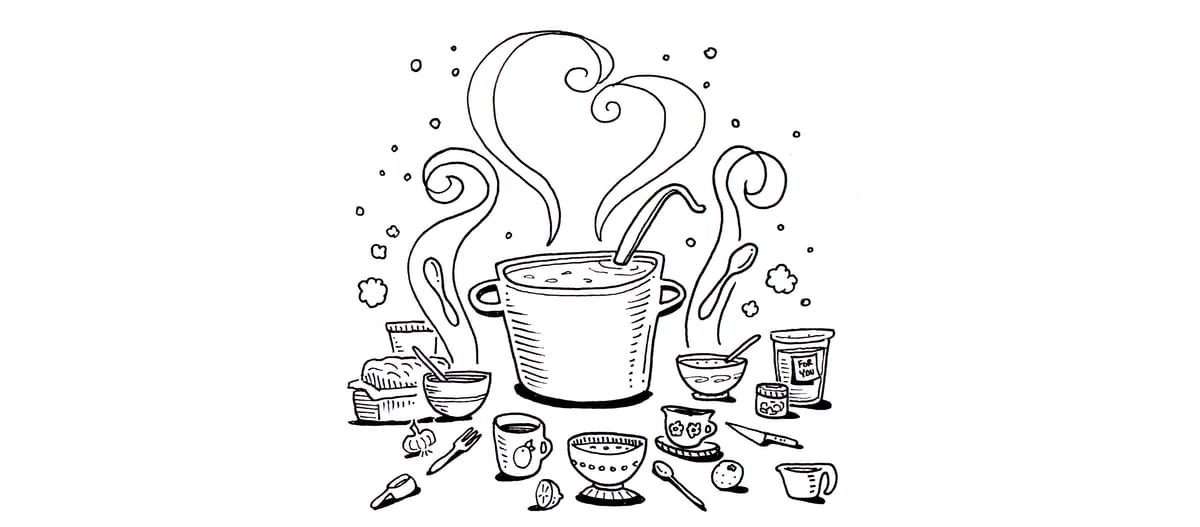
The table is where revolution begins and refuels, well-fed.
I'm sick again, which my brother Gavi reminds me is the body's way of asking for attention and care. It's a normal head cold, better with a few days rest. These days I'm not so sure whether to trust a couple negative rapid tests, but I lie low just in case, intending to continue my usual masking routine when out and about. It's the time of the year where respiratory illnesses are high—COVID is making its rounds alongside RSV and the flu. And if it's none of these things, it's something else dingy, all of us stuffed inside from the winter cold.
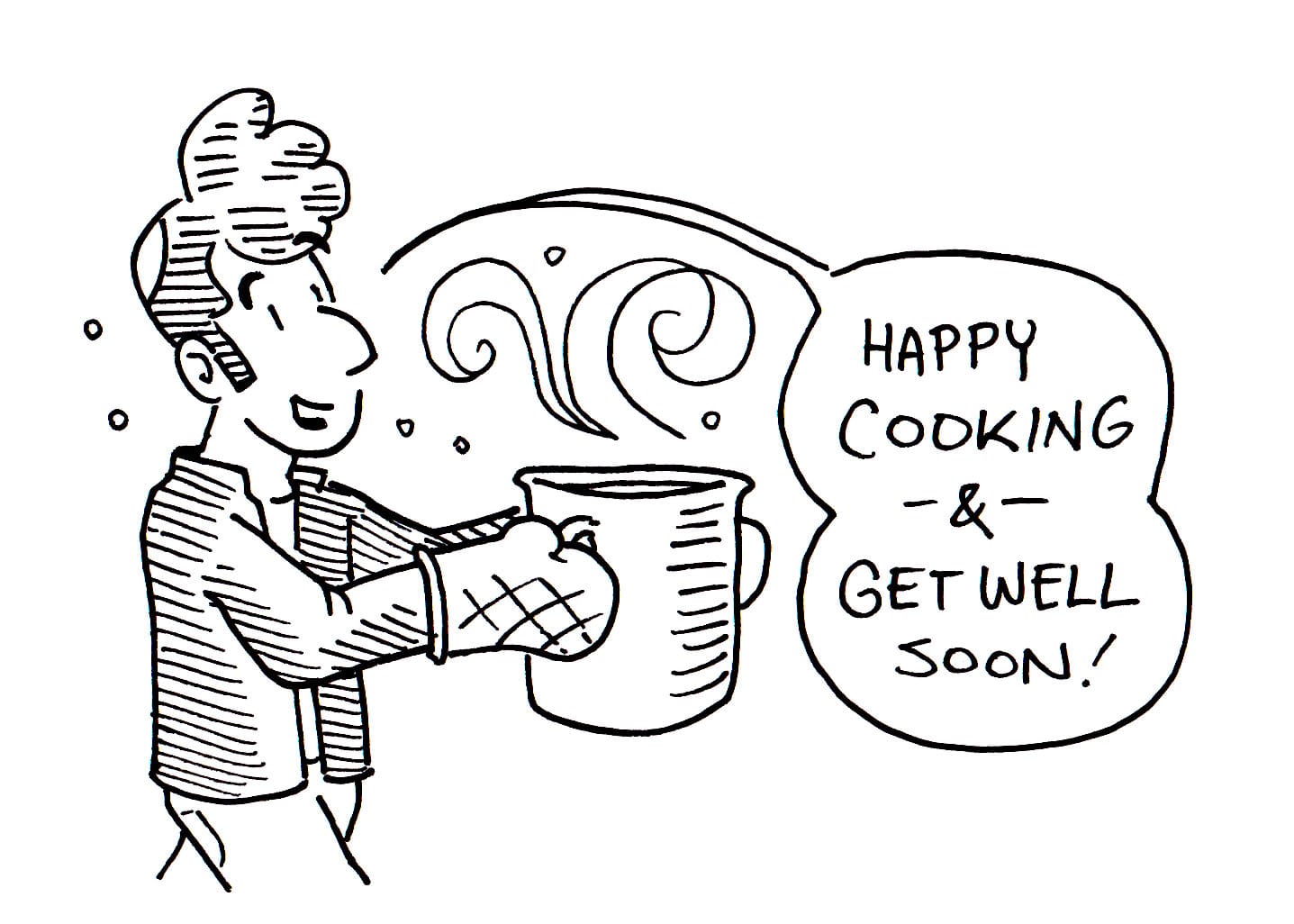
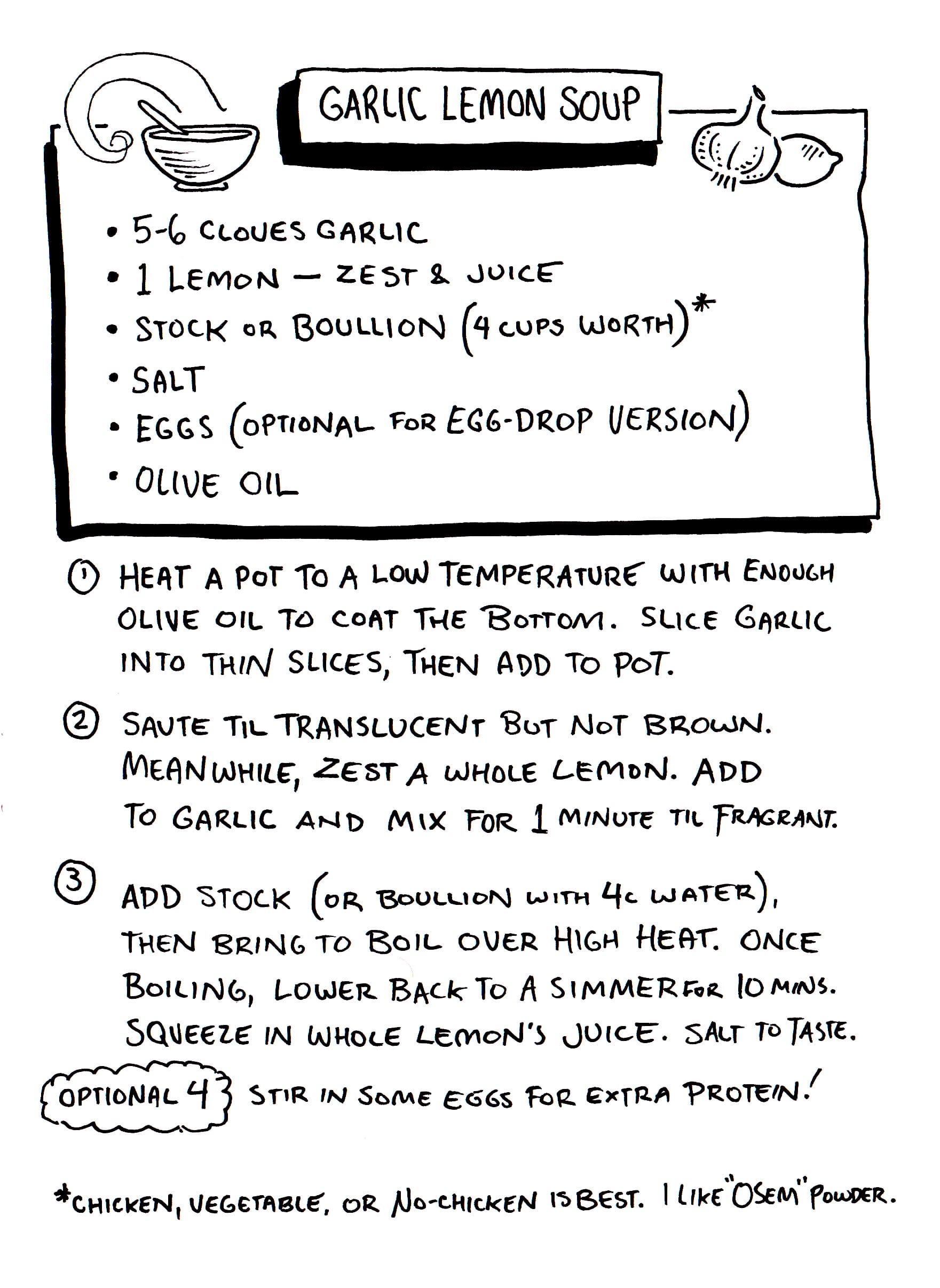
In service of keeping this newsletter illustrated while honoring my physical limitations at the moment of my writing, I'm going to talk about the revolutionary potential of your kitchen while walking you through my new print-at-home, pay-what-you-want flu-season zine that I released last week, just in time to get sick myself: Recipes To Heal Yourself & Your Friends.
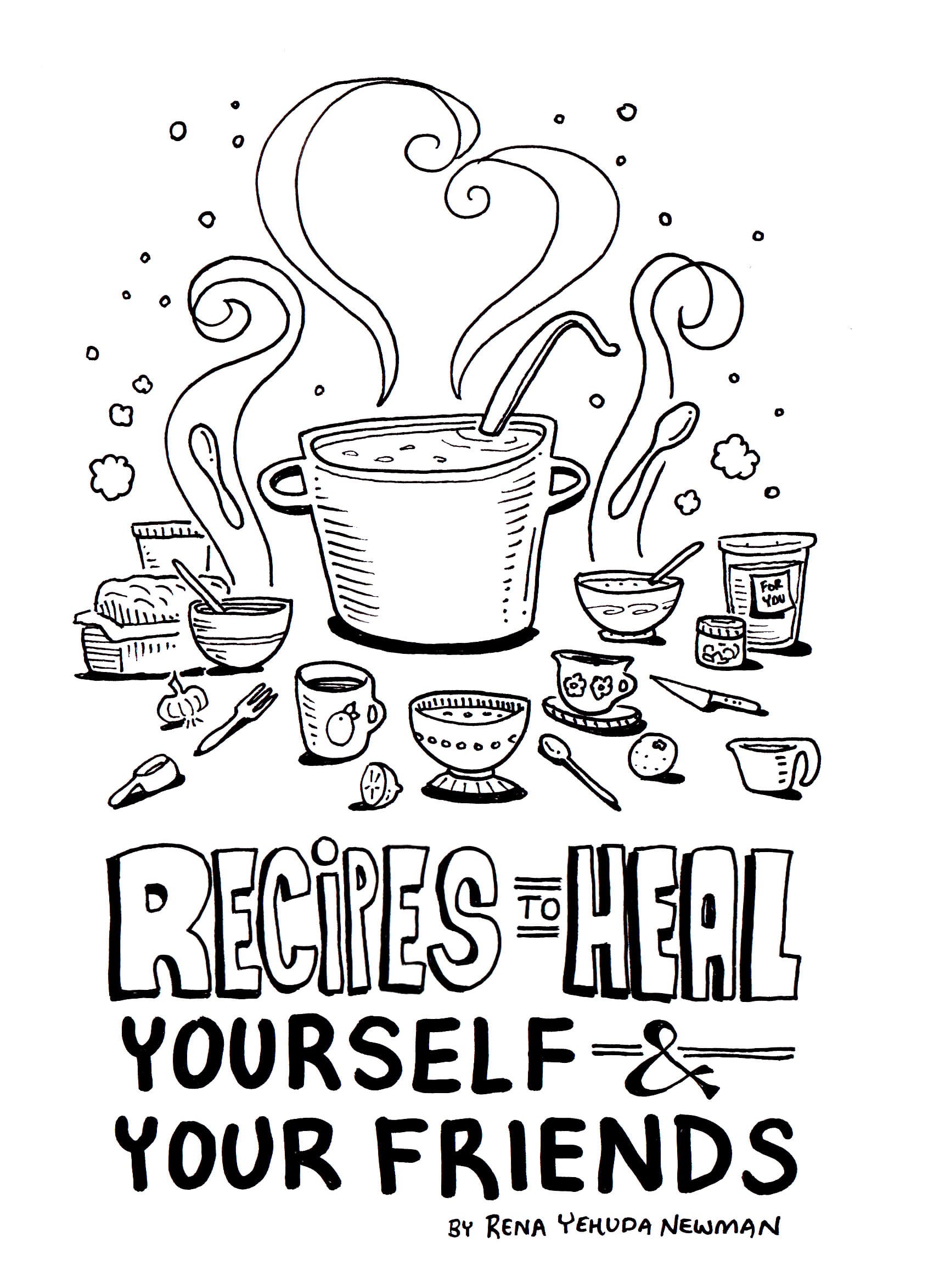
For me, one of the worst parts of feeling sick is not having the energy to cook. Food is medicine, and when I feel crummy, it's extra tragic to not be able to properly feed myself the ways I need to heal. Over the years, I've developed a relationship to a few go-to recipes that are easy enough when I'm exhausted, and almost always make me feel a whole lot better. I put this zine together after a Shabbos dinner where my garlic lemon soup made the guests demand the recipe. I started thinking more seriously about the link between cooking, prayer, and action.
It matters to me tremendously to cook for my friends and community when they get sick. It's a simple act of care that's high up on my list of priorities. I keep spare plastic soup containers around for this purpose so nobody has to worry about returning tupperware. If you want someone to know you care about them, bring them food when they're ill.
Though it may seem deceptively basic, feeding people is among the most historically political and politicized actions. In other words, if you want to fight the power, you're going to need a huge soup pot.
I got my chops as a big-group cook at the co-op I lived in after college, a enormous 28 person household with an industrial kitchen. We had "cookshift" every day, where two people would make dinner (or Sunday brunch) for the whole house on a weekly rotation. It took three hours. My cookshift partner Sara, who'd lived at the house much longer than me, showed me the ropes: giant batches of roasted vegetables, enormous squash galettes, a blondie recipe in a mixing bowl the size of my torso that she baked by heart. We cooked all kinds of things based on whatever was in the communal fridge and whatever seemed beautiful or exciting.
The pantry's hand-built spice rack towered over us both, litre mason jars holding quantities of spices that would've made medieval kings jealous. I learned how to make gallons of potato leek soup with herbs de provence and an immersion blender, batches of enchiladas that required serious biceps to lift, and even tried collective dreaming with mugwort tea after hours, standing around the beautiful wooden chopping-block island another housemate built nearly a decade ago—it had a compost hole right in the middle, to throw your scraps into a replaceable plastic bin below. It was here I learned the physical, spiritual, and skill-based architectures required to feed the village; they're always handmade.
There is a reason that the Black Panthers focused a huge part of their energy on feeding the people, especially children. In spite of what the feds will tell you, it was this tactic of organization that made them most dangerous to white hegemony. Food unites people. It builds trust. It quite literally helps people survive.
Events like the Irish Potato Famine and the mass starvation of Gaza were intentionally engineered to coerce a population into submission via collective punishment. To control the means of producing or distributing food is to control a whole people. Food is love. What is its absence?
In the Talmud, Yoma 75a-b, there is a discussion between the rabbis about why the Israelites complained about the manna that miraculously dropped from heaven and fed them in the desert, famously bemoaning how much they missed—specifically—the melons, cucumbers, leeks, garlic, and onions. Was it because they were ungrateful? The rabbis debate how the manna tasted like these things but didn't have the texture, and vice versa, describing how the food was unfamiliar and therefore upsetting. Rabbi Yochanan later goes on to make a particularly disturbing claim: the manna was absorbed directly into their bones. This food was alien, strange, and even painful on the bodies of the Israelites. The manna wasn't digested as the foods they had known; despite its miraculous quality, the Israelites were deprived even of the basic human comfort of feeling full. This intense discomfort, based in the very nourishment they were receiving, caused them to feel further from G-d.
In a world ravaged by COVID, more people are getting more sick more often. As fascism rises, the powers that be instigate (or facilitate) mass disabling events worldwide, whether by ignoring healthcare needs or dropping bombs on civilian populations. Teargassed protests and ICE raids are also disabling events—the government using warfare on the people's bodies and minds, causing both physical and psychological trauma, and brutalizing our collective ability to resist. Word has it that ICE agents are chasing down white folks in Minneapolis who look like they're going to deliver groceries to homes protecting migrants. This is hardly a coincidence. Food heals our bodies, sustains us. It is one more crucial tool in our collective toolkit to heal those who have been targeted or are doing frontline work against the terrors of this regime.
We need to learn how to cook for others repeatedly, with endurance, as part of our regular routine, not just for people in moments of sudden crisis but for our community members who are chronically ill, elderly, or living with longterm disability. This is a long game called interdependence. It's better than the individualism we got served up.
How much more important is it that each of us refines the skills needed to sustainably care for one another! How significant it is to know how to prepare garlic lemon soup!
This week I've been thinking a lot about Georgia Gilmore, the civil rights hero who quite literally fed and funded the movement. Gilmore was a midwife and kitchen activist who understood the material needs of grassroots work. She ran a cafe out of her home where movement leaders met to connect, celebrate, and plan. Those tables birthed trust and strategy; nothing is quite so powerful a social force as breaking bread together.
Gilmore would sell cakes, sweet potato pies, stewed greens, and fish outside of beauty parlors and churches, donating the proceeds to keep alternative infrastructures running—gas for carpools during the Montgomery bus boycott, groceries for workers fired or on strike. The money came from so many people that it was untraceable, which made it impossible for the FBI and cops to mess with. Now that's mutual aid praxis.
These same tactics are crucial now, and we inherit a rich template from activists like Gilmore: cooking is a superpower for any resistance movement.

Recently I've been seeing a whole host of hyper-local trust building ideas to build a village in your city, get connected with our neighbors and keep people safe. Notably, this particularly great zine about it, "How to Build a Village In Your Zip Code" by dhivya. Here are some low-stakes ones that have a high impact, many of which come from their zine:
- Find a community fridge or little pantry (a la little free library) and pick a day every week you'll stock it with basics
- Make an easy meal or treat—sandwiches, soups, cookies—then drop them off on your neighbors' porch with a note that says who it's from and that there's no need to respond.
- "We made extra" dinner: portion it into a container and include a note that says "zero need to return this".
- Phone tree: create a group chat (on Signal, WhatsApp, or another commonly used platform) then distribute a slip to your neighbors to let them know, "if you need help with something, text this group."
- Find a local rapid response group and respond to concrete asks, specifically food-based needs like groceries and meals.
- A way to support someone in grief, trauma, or having a health issue: help them go through their pantry and fridge and make a list of what's there and what else they need. Then do the grocery run.
- Cook a dinner for your neighbors or comrades. Make too much food. Ask people to bring containers for leftovers, or provide them.
In white America, there is hardly any apparatus for grief. And if there's no ritual or space for grief, there's little capacity for true joy. America mistakes joy for consumption or comfort. However, joy is not the absence of grief but a full-hearted experience that lives in concert with it. I have observed this vacuum in whiteness because being a white Jew under white supremacy means seeing double.
We are coming upon Purim quickly, the Jewish holiday of the upside-down. It is a holiday in which grief and joy, rage and celebration switch, flip on a dime. These emotions coexist and spin so quickly we're left unsure of everything we thought we knew. The side-by-side of grief and joy highlight one another, deepening the experience of both.
Judaism is filled with spiritual tools and outlets for the huge emotions that keep revolutionary action possible and alive. Food is almost always at the beating heart of them. It's what is exemplified in Purim's custom of mishloach manot, giving gifts of food to your neighbors, alongside donating extra money for tzedekah. It's at the core of remarkable Jewish anarchist projects like the pink peacock, a queer Yiddish cafe that served hundreds of people luxurious food for pay-what-you-want-down-to-zero for three years in Glasgow and aspires to rebuild itself in Brooklyn. It's what animates Shabbes as the rhythmic ritual that has kept us spiritually alive for thousands of years.
Shabbat is a weekly technology that Jews have used for centuries to metabolize despair into dreaming and building. Every Friday I cook something special. I host as often as I can, usually bringing Jews and people who love us to my table with the hopes of creating a place where, at its best, we can be honest about the grief of the world, bear witness to one another in a way that helps us feel less alone, and, in doing so, see the world to come. This happens over garlic lemon soup. This happens over freshly baked challah. This happens because the food I cook is a prayer that finds form in the bodies of my comrades.
To cook is to pray. My friend Shlomo taught me this when would send photos of his Shabbos stews to the mothers he fundraised for in Gaza, with blessings for them, cooking in their honor. They would send photos of the meals prepared, even in the midst of famine, with blessings of their own. Sanctified by their ingredients, these blessings reached up to shamayim, into the worlds of creation high above our own. If done this way, the meal contains kavana, holy intent. Bless your food as you make it, in the honor of another, with the love of the divine. The prayers of cooks nourish our bodies and connect us to others across oceans, space, and time.
To be fed is to be held. To be fed is to be, in the most immediate physical sense, less alone. We cannot do any of this alone. Cook for your friends. Cook for your neighbors. Cook for the stranger. Cook for the sick. Cook for the hungry. Be cooked for. It is among the greatest mitzvos to feed the hungry and to visit the sick. Feeling full and being able-bodied are both temporary statuses that can change at any time. Treat that precarity with great love. Now is the time to take care of one another, one bowl at a time.
How will you use your kitchen?
Thanks for visiting my newsletter. Your readership, feedback, and support means the world to me. Thanks for being here. If you'd like to subscribe, it's always free—but if financially supporting me as an artist is feasible and matters to you, you can subscribe to my newsletter for just $5/month or send a one-time donation here.
Tzedekah Opportunities Ahead of Purim:
- An urgent, time-sensitive ask to get a family to safety: A friend of mine has been working with a Gazan woman named Neveena and her family for the past few years. Neveena has the chance to evacuate to Egypt via Rafah with her 3 small children, but they need at least $2000. (If every newletter reader sent $20, we'd have it funded). My friend has poured their own money into Gaza and needs the help of those who have more to give. You can get Neveena and her children into Egypt by sending support funds via Zelle (ethne.dennis@gmail.com) or Venmo (@ethne).
- Affected by ICE Raids: A friend's neighbor is in need of funds for his son's emergency surgery. He has lost wages due to the ICE raids, and the community is raising $2000 on his behalf. You can donate via venmo to @sheli-stein-69.
- Support the creation of the pink peacock's free food cafe in Brooklyn, NY, with a mission of pay-what-you-can-down-to-zero meals and luxury for all. Donate here.