Getting Serious About the Mitzveh of Tzedakah in 5786
Welcome to my newsletter. I'm so grateful to have you subscribed, following along with my comix, essays, drashot, and observations in these terrible times. This essay was originally published ahead of Yom Kippur, but is now being released as a newsletter ahead of Sukkot.
I've been inspired by many friends of mine, including Misha Holleb and Aron Wander, who publish thoughtful newsletters that illuminate our present crises and allow for more intentional engagement with hard topics off of social media. I aspire to follow in their footsteps with mine.
I'm hoping that this new medium will give me a reason to create more regularly and a public place to put that work. Many of these entries will be a mix of comic and writing, published on a biweekly (that's every-other-weekly) basis. Your readership, feedback, and support means the world to me. Thanks for being here. These newsletter subscriptions are always free, but if financially supporting me as an artist matters to you, you can subscribe to my newsletter for just $5/month. Or, you can send a one-time donation here.Without further ado, here's my first missive.
There has hardly been a moment in my short lifetime when the brokenness of the world is more violently clear. What does Teshuva possibly look like in a time where Jews commit genocide, when the sin of worshipping the idol of nation-states has become a central tenet of institutional Jewish life? In accepting the Torah at Sinai, we made a contract with our Maker not to be like other nations. Yet here we are, an unrepentant mirror, blaspheming our most ancient promise by assimilating into the worst traits modern nationalism has to offer.
We are now at the end of the Yomim Noraim, the Days of Awe, that liminal period between Rosh Hashana and Yom Kippur. In these fast-moving moments, the Book of Our Days is open. G-d is writing, but the decree is not yet sealed. The world is made in word, deed begins as scribing. We have this time to wake up, to do the work of turning, before the gates close. How can we move the writer's hand? How can we become the authors of our own fate? The machzor is explicit and repetitious about what that entails: Tzedakah, Tefillah, and Teshuva.
Before the gates close tonight, I want to focus for a moment on the first of these three actions.
The other two get their limelight: The majority of mainstream Jewish institutions place a large emphasis on Tefillah, on prayer, this time of year. Though I’m not sure the kavana, or intention, of that Tefillah is as emphasized among big shuls, Rosh Hashana and Yom Kippur are always the year's biggest services. Even my vehemently secular father is willing to be dragged to the Reform synagogue I grew up in (where he tells me he replaces every machzor instance of “God” with “Good” in order to make sense of it). Though, like Tefillah, Teshuva is rarely truly done, it still gets lip service from the pulpit. Teshuva, turning, repentance, return, is the central axis on which we move from olam hazeh, the world as it is, into olam haboh, the world to come. It’s the spiritual motion that undergirds actual transformation. And yet, the list still begins with Tzedakah.
Tzedakah is the material engine behind Teshuva. It’s the way that we can impact the lives of others directly, to fulfill our obligation of repair in an inequitable world that Torah and Talmud both experienced and foresaw.
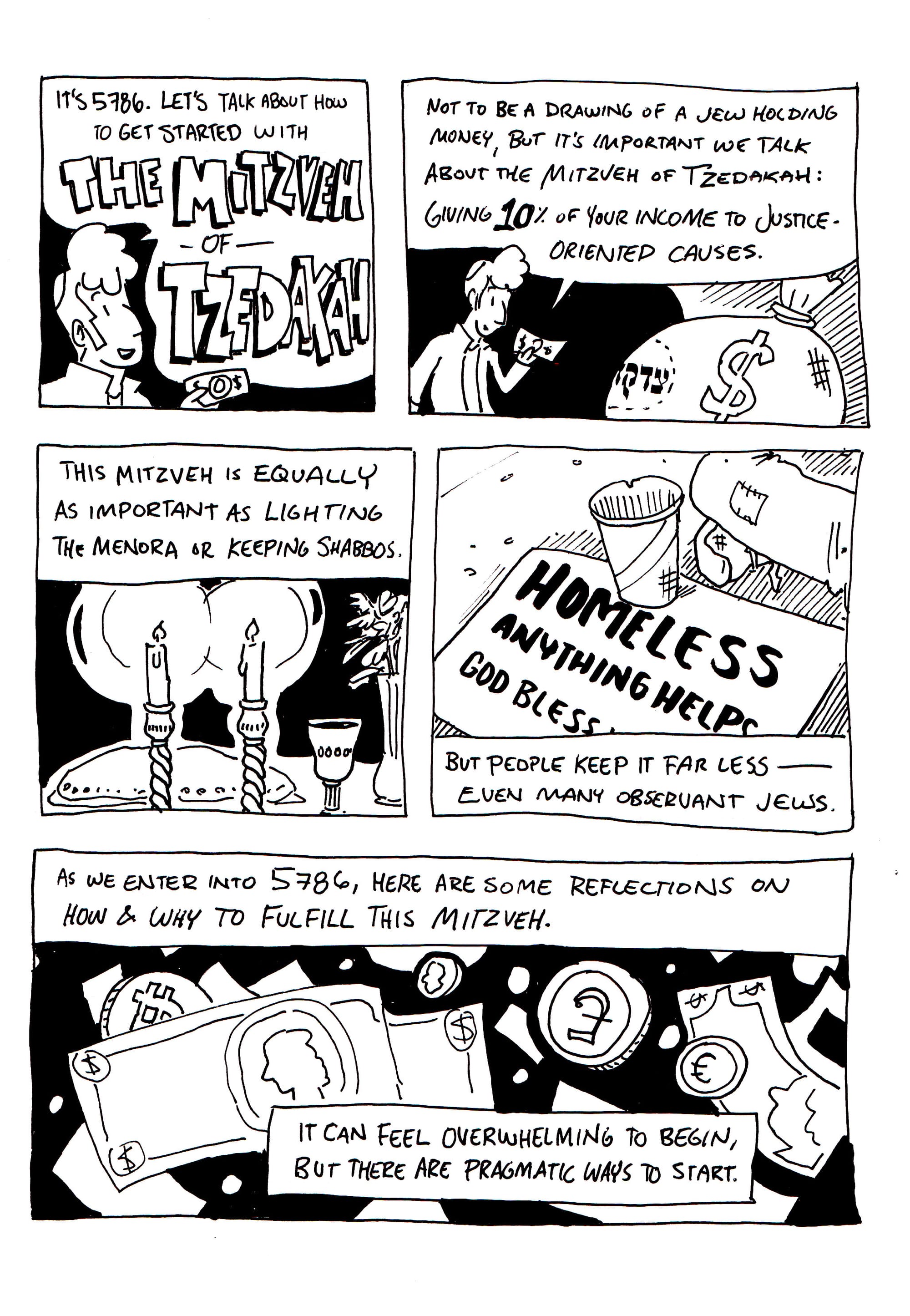
Tzedakah (צְדָקָה) is often translated as “charity,” but this linguistic choice is so Christian that I have to call it a mistranslation. Tzedakah derives from the root tzadi-daled-kuf, or “Tzedek”, meaning justice or righteousness. Giving Tzedakah isn’t a charitable donation that one does out of the goodness of one’s heart as an optional, praiseworthy, and tax-deductible expression of altruism. One doesn’t give Tzedakah because it’s the right thing to do, but rather because one is obligated to do this right thing.
The principles of Tzedakah are originally derived from agricultural law. Neither the corners of one’s field (the pe’ah) nor the fallen fruits of an orchard were to be harvested by the landholder. Instead, these were left alone so that the poor in the community would be able to easily and privately glean what they needed. (Leviticus 19:9) The Torah doesn’t specify a particular amount to allocate, and as currency became part of the world of the Rabbis, over the next few thousand years, debates would emerge about the right percent to give to Tzedakah. Applying the rules for tithing, today the standard rule is to give ten percent of your income to Tzedakah. And unless there are extenuating circumstances such as extreme wealth, one is not permitted to give more than twenty percent, lest the giver may themselves become in need during the process of giving. There are lots of other guidelines about the ethics of Tzedakah, like Maimonides's Ladder, but ten percent is the foundation.
Given that this is so clearly now halakhic law, why is it that we hardly see people engaging in this mitzveh today?
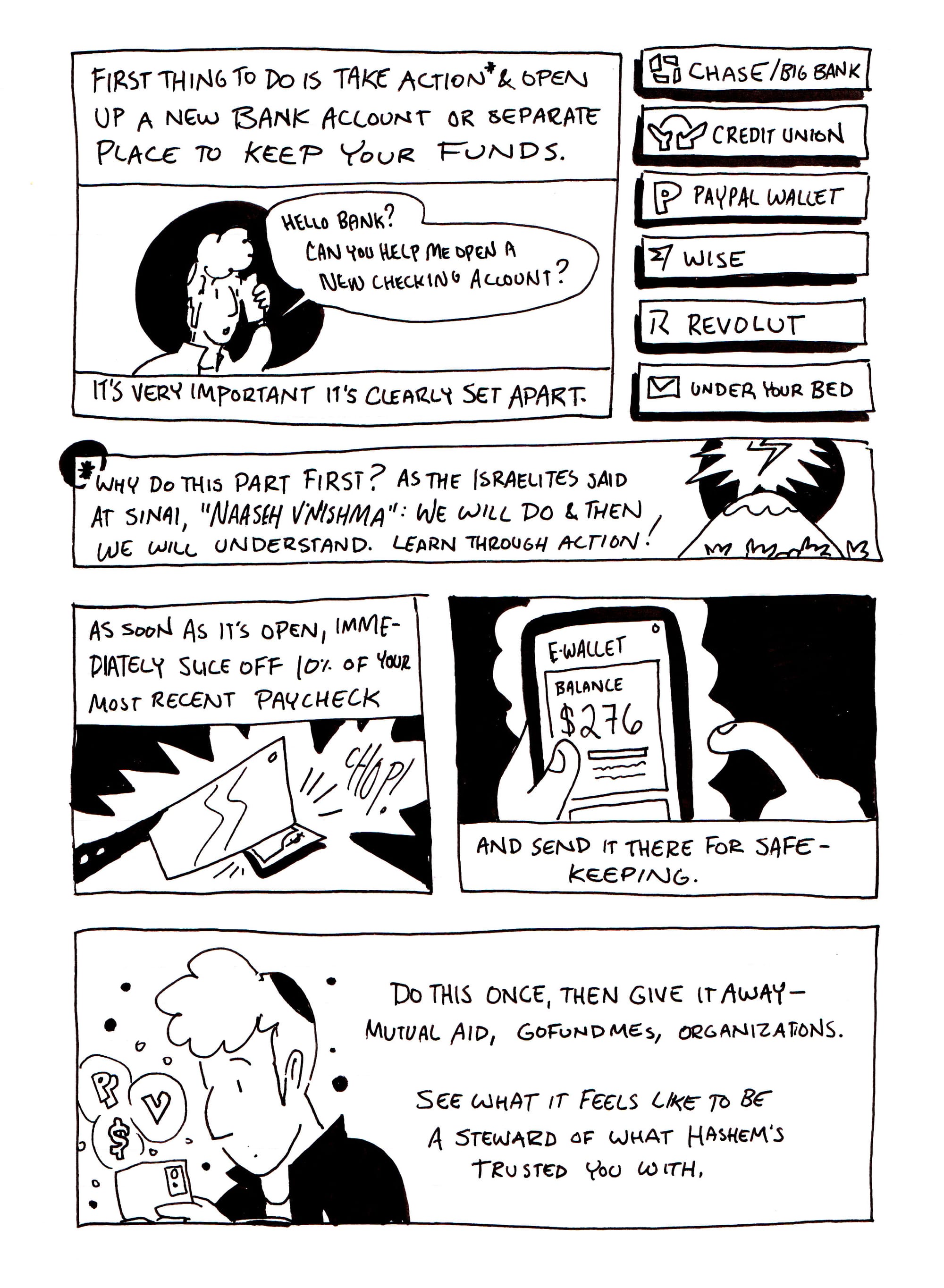
As a young student, I am grateful to have sat in a shiur, a class, taught by R’ Elie Kaunfer at Yeshivat Hadar on the topic of giving that ten percent. While I find the class politics and money-based assumptions of the Hadar Institute worthy of immense criticism (which I won’t cover here), I do have critical support for what I learned in this shiur. On a whiteboard, R’ Elie wrote out his salary and went through with us, line by line, about how he budgeted to ensure he could give ten percent, every year. This shiur made a serious impression on me and I resolved to do the same when I had money to spend. As soon as I got my first job out of college, I opened up a separate bank account exclusively for giving Tzedakah. It is the same one that I use today.
I share this story because there is truly nothing special about me having a Tzedakah account, other than whatever is inherently special and beautiful about fulfilling a mitzveh. I’m writing about it because I believe everyone can and should do the same, with the hopes that it should become unremarkable that each Jew (and perhaps even non-Jew) would obviously give at least ten percent of their income to materially create more justice in the world.
If you are employed and don’t do this already, I can hardly think of a moment in my lifetime in which beginning this practice could be more meaningful or useful. It’s a new year, as the genocide rages on: the chagim are a time for turning, for making another choice. Now is the most excellent time to get serious about pragmatically gathering the means to help fight authoritarianism, moving whatever cash is lying around among middle-, upper-middle class, and wealthy progressive Jews. Everyone can do their part to aid the victims of genocide and give mutual aid to those in their community facing the crosshairs of fascism. Get started with that mitzveh and call your bank right away.
(Or use a digital international wallet like Revolut, or better yet, support a local credit union by opening up an account there. But do whatever is easiest right now, whatever will be simplest to spur you to open a Tzedakah account.)
The pasuk (verse) immediately following the laws of pe’ah reminds us not to steal, or deal deceitfully with your fellow. (Leviticus 19:9-11). These things are deeply connected: harvesting from the corners of your field isn’t “uncharitable"—it’s theft. Rabbi Shimon elaborates further on this point (Tosefta Pe’ah, 1:7): “They said that a person must leave pe’ah only at the end of the field for four reasons–because of theft from the poor, wasting the time of the poor, for the sake of appearances and because the Torah states ‘You shall not reap all the way to the corner of your field.’”
Rabbi Shimon emphasizes that in allocating a portion of your income for Tzedakah, there are four serious considerations: (1) to make sure they are given what they are owed, (2) to not waste the time of someone in need, (3) to set an example for others who are more fortunate, and, (4) finally, because the Torah says so.
The corners of that field don’t belong to you, they belong to those who need it; to harvest it for yourself is theft (not unlike wage theft). The field itself doesn’t belong to you, it belongs to Hashem. You’ve just been entrusted to be a good steward of it. In this way, Torah makes it clear: we all belong to each other. At its best, how we deal with parnosa, livelihood, money, or income, should always express that.
How arrogant would I be if I believed that Hashem has had no role to play in my incredibly good fortune of being a trans faggot employed by a Jewish non-profit that sees Torah in my anti-nationalism during the rise of American fascism? Whether you call it privilege or bracha (or both as the case may be), it is obvious that the money I make isn’t mine to keep, it’s mine to steward. Because of that, I will do my best to act in ways that merit the trust of Maker. Plus, and I can't emphasize this enough, it’s phenomenal to have a designated bank account linked to my Venmo, Paypal, and Cashapp so that I can easily and always give to whatever mutual aid ask I see on my newsfeed. As a transsexual under this regime, there is no shortage of people to send cash to. I have my own teshuva to do for the moments in which I have callously passed over a request—my observance of this mitzveh leaves me no excuse. I wish more of my peers in the white Jewish world would do the same, especially those who have not personally faced hunger, who were also raised through institutional Judaism. We’re all meant to carry this burden together.
It is our duty to redirect money to where it’s needed most, to take care of people we love and people we don’t yet know. Isn’t that what money’s for?
Imagine if every synagogue emphasized this mitzveh among its congregants. Imagine if Jews on the Left ran a kiruv campaign for this mitzveh as strong as the Chabadniks do for wrapping tefillin or shaking lulav? Imagine if every group of Jewish friends who assembled for Shabbes dinner also assembled their Tzedakah to provide immediate aid to Gazans starving under blockade, to sponsor a refugee reestablishing in a foreign land, to help with rides for people needing abortions in other states, to supplement income for immigrant families shattered by ICE, to pay the rent of a trans youth who’s been kicked out of their home? What if there were always funds available for mutual aid, for tuning pianos in our co-operative homes, for groceries for single mothers and our chronically ill friends, for cut flowers for our neighbors recovering from COVID? What if we were as serious in our observance of Tzedakah as we are about lighting candles or making kiddush?
Now, more than ever, we have to create alternative systems. As the fascists in the United States slash what few social services we have, it’s crucial we create robust ways of funneling wealth to where it’s needed most. No more Leftist pearl clutching or purity politics about the origins of that money, no more liberal discomfort in talking about class and income. Just think of the material impact we could have if every Jew with a conscience (and a salary) observed this mitzveh and put their money where their mouth is.
As the Israelites say when they receive the Torah, “Naaseh v’nishma!” or “We will do and then we will understand!” Hurry, start today! If we begin here and now, then we’ll have even more blueprints for truly equitable systems in olam haboh. You have to do the thing to know the thing. There’s no way for us to intimately know what justice looks like until we make it happen in the smallest places we can. We look to history to teach us those lessons in retrospect, but we have to look to our own lives to learn them materially, by way of daily and mundane practice of mitzvos like Tzedakah.
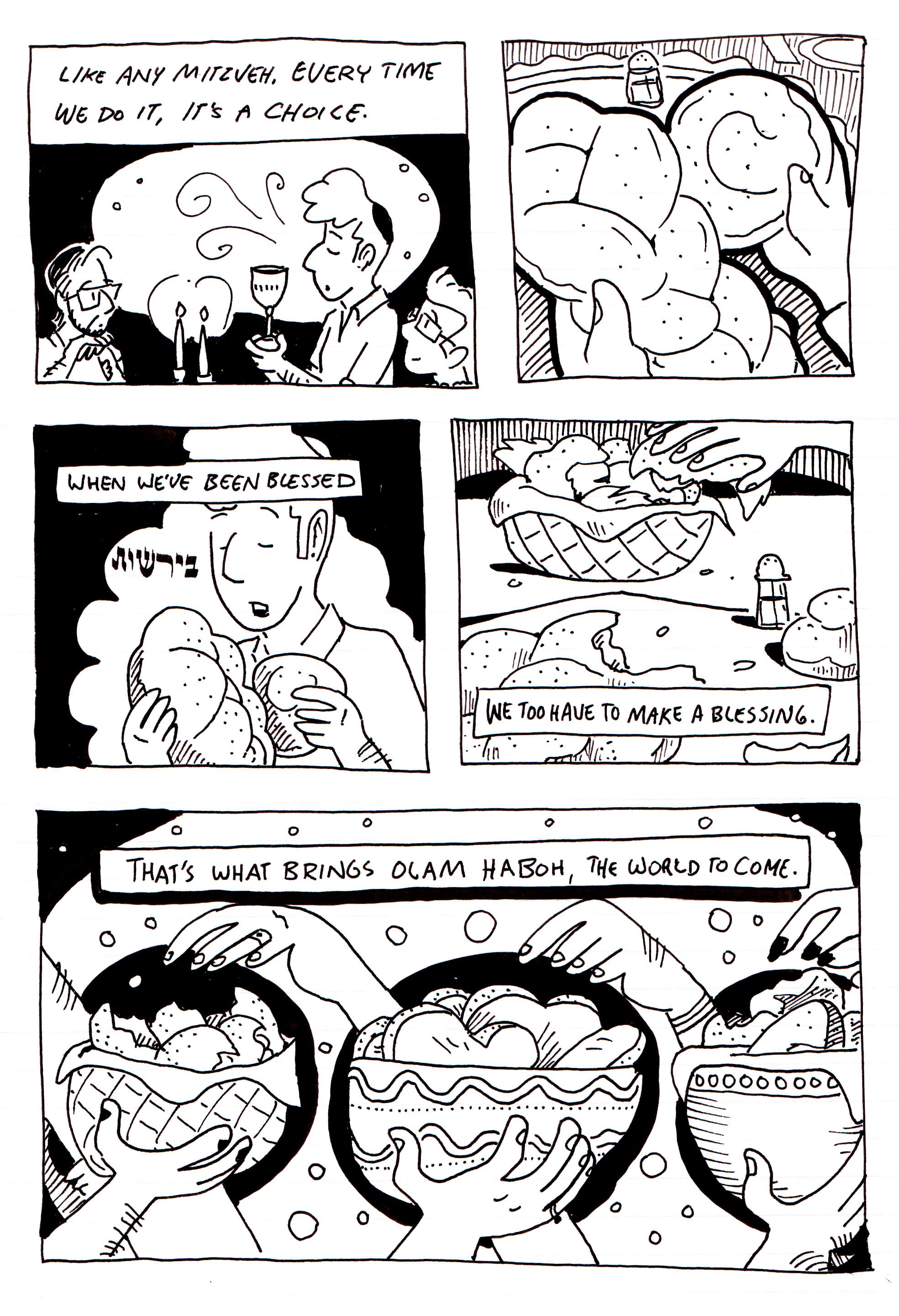
In a more just world, the structures we’ve built would ensure that no one is hungry, that everyone is housed, that we all have clean water and air, that we have the time and resources to connect meaningfully with one another, enjoy the fruits of our labor, create art, grow flowers, and fully savor the world that G-d created. Reparations are a large-scale project—no individual can give them for a collective sin. G-d willing we will work towards actions that enable that collective teshuva. In lieu of that world, we have to make justice in the smallest corners of creation: our own fields.
G’mar chatima tova. May those in Gaza live to see another year and the immediate end of this genocide. May we make teshuva so great that it merits we be inscribed in the book of life.
Looking for the first places to give that first ten percent? Here are some fundraisers from friends, community members, and vetted folks overseas.
(Note: Whenever I share fundraisers for people in Gaza, they're run by people I know personally, who have been in touch with the recipients, often for many months. Help them continue to carry out this immense mitzveh of caring for the refugee.)
(1) Supporting Areej, a fourteen year old girl who's been running a fundraiser for her family, the al-Shafi family, to survive winter in Gaza.
(2) Helping my friend Moses, a brilliant Black trans man, student, fiber artist and frum Muslim cover housing and food while he's been kicked out of his family's home after coming out to them this month. You can send funds to his Venmo (@Iman-Yusuf) or Zelle (646-752-3331) (And if you have any job leads in Health Administration, please let me know so I can pass them on to him.)
(3) Supporting five Gazan medical students pay rent as they get resettled in Egypt to continue their studies.