What Can An Image Do In The Face of Genocide?

Welcome to my newsletter. I'm so grateful to have you subscribed, following along with my comix, essays, drashot, and observations in these terrible times. Many of these entries will be a mix of comic and writing, published on a biweekly (that's every-other-weekly) basis. Your readership, feedback, and support means the world to me. Thanks for being here. These newsletter subscriptions are always free, but if financially supporting me as an artist is feasible and matters to you, you can subscribe to my newsletter for just $5/month or send a one-time donation here.
Yesterday, I received news that a friend of a friend had been shot in the stomach. This friend of a friend was in critical condition, a father of three. And crucially, he is Gazan, shot just a day before the ceasefire "was allowed to" begin.
The surgery Mahmoud needs costs money, which is of course horrible, and these days when I have a direct enough connection to a story, I fundraise through my art. My friend, who has been in touch with Mahmoud for the past two years, hearing about his family and daily life in beseiged Gaza, tells me the next surgery will cost $3000. I sat down in a couch corner and attempted a simple comic that was dual purpose: trying to express a fraction of the constant inexpressible grief of these last two years, and trying to use that feeling to move some of my followers to give to Mahmoud.

While I drew, I felt the strange weight that has become characteristic of art I'm bent on sharing. Over the past two years (and especially the first year) of the genocide in Gaza, I have felt more creative paralysis than ever else in my life. Not because I cannot figure out what to make, but rather because there is so much to make and I hardly know where to begin—or how to share it. My feelings of responsibility for Jews and for non-Jewish death spiraled in contradictions. Should I just express my rage, grief, and confusion, or exercise enough emotional restraint to be strategic and ministerial? What can I do to move others to action? I collapse down rabbit-holes about the worthiness or usefulness of my commentary, given my privileges, lack of knowledge, and entanglement.
My internal critic sounds more like a judge from the Nuremberg trials in which every day is Yom Kippur. I confront or cower away from the million ways I have acted as a bystander, complicit in the crimes of both a state that claims to represent my people and my state of origin, which gives billions of tax dollars (and which will tax me wherever I am in the world) for the purpose of displacement and mass murder. I don't want to misspeak, to participate in the fiction that I must have a take before I've even begun to understand the issue in front of me or my connection to it.
Yet, being silent is still the greatest crime of all—especially when speaking may mean that someone eats today, and all it costs me is a drawing.
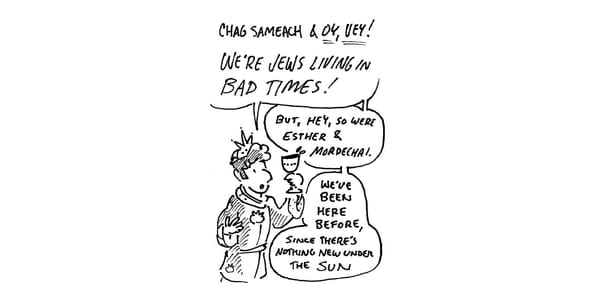
I made my own donation, then wrote the comic. I took photos of it, unedited on my phone, straight from my composition notebook, and posted it on my story with the link to Mahmoud's fundraiser. Anxiously, over the course of the day, I refreshed the crowdfunder page to see many names of friends and followers, kind and thoughtful people, who saw what I'd drawn and felt moved enough, even after two years of constant killing, to click the link and give something. This resulted in at least $500 worth of donations.
So why was it, exactly, that of all the things I could've done, I made a comic? And why is it that a comic is what moved people enough to give?

As donations rolled through the day, I found myself inside of an uncomfortable meditation on my own power and responsibility as an artist. It's a grim anecdote: a father was shot in a warzone by a Jewish soldier who will likely never face justice, the Gazan medical system is so dire and war is so profitable that he has to pay a lot of money to have lifesaving surgery, and a not-insignificant portion of that money only made it to him because a Jewish transsexual with enough financial connections decided to make a drawing online. In olam haboh, the world as it could be, Mahmoud would not be shot, medical care for refugees (or anyone) would not cost $3000, and life or death would not hang in the balance of single, small actions that highlight the inequity of the systems we find ourselves born into. In olam hazeh, this world, we have to act knowing that the stakes really are that high.
After months and months of feeling powerless to stop the bombs from dropping, to stop the bipartisan American war-death machine from funding them, first under Biden, then under Trump, it is easy to forget the strength rooted in our unique talents, skills, and connections. As an artist, and especially a comix artist, I'm obligated to remember exactly what power exists through the ability to make image and story.

Images reach deeper than words alone. Of all of the Holocaust literature I've consumed over the course of my life, starting from a terribly young age, it is the images of bodies bulldozed into mass graves and the drawings of Art Spiegelman in Maus that stay with me most intimately. Throughout these last two years of genocide, the daily drawings of Palestinian artist Maisara Baroud have broken through the newsfeed-induced callousness I've developed to cope with the horrors and the cognitive dissonance of my distance and complicity. His documentary drawings reach a place in me that photographs and writing cannot go. They save me from descending into a state of G-dlessness: where I have cut off the faculty that allows me to witness the suffering of others, and therefore the suffering inside myself.
A drawing can contain not just visual expression, but the element of prophecy that can be found in dreams—indeed, drawing comes from the same place in us as dreaming. Image is limited in what it shows but unbounded in its meaning. In that gap, a unique holiness can shine through the act of interpretation. Ambiguity, metaphor, uncertainty, abstraction, and gesture all create that opportunity. The moment in which a person makes meaning of an image is a doorway. There, we can recognize the connection between the world outside of us and our neshamos, our souls. When we talk about being made in "the image of the divine," I really believe this is what we're describing. An image can be a mirror that allows us to situate ourselves—personally and politically—as a sacred part of a greater world.

I've been reading Hannah Arendt's Eichmann in Jerusalem (available in book format, or in the New Yorker archives, the publication for which it was originally written). Arendt emphasizes how social complicity in genocide happened through individuals asking for exceptions, rather than demanding wholesale changes to an unjust status quo.
When asked if he faced people protesting his work or rebuke for doing the evil of deporting people to their deaths, Adolf Eichmann replied that no, no one had done that—and Arendt thinks he may be telling the truth. Germans who wanted favors for their "favorite Jews" were polite to him. Even the Jews of high standing, who had enough connections to beg for better treatment in the camps or escape routes for their families, apparently asked only for this and not more. They all wanted exceptions, which conveyed an implicit acceptance of (or psychological defeat by) the rule: mass death.
"But if the Jewish and Gentile pleaders of 'special cases' were unaware of their involuntary complicity, this implicit recognition of the rule, which spelled death for all non-special cases, must have been very obvious to those who were engaged in the business of murder. They must have felt, at least, that by being asked to make exceptions, and by occasionally granting them, and thus earning gratitude, they had convinced their opponents of the lawfulness of what they were doing." (Eichmann in Jerusalem, Penguin Classics, p. 130)
In making a single comic for a single person suffering in a way that is not singular but rather emblematic of an entire group of people, I am responsible for being specific about the uniqueness of that person and the terrible rule of his circumstances. Miraculously, my medium allows for that zoom-in and zoom-out to happen simultaneously. Images—and especially comix which, according to Art Spiegelman, "co-mix" text and image—allows us to experience specificity and interconnection all at once.

I wonder sometimes if we tell ourselves that we're powerless so that we don't have to face just how much power we really have. For if we truly and intimately knew our own power, we would have no excuse for inaction. We would have to confront the suffering we have condoned (or even created) in our midst—and grieve it. In order to not freeze or turn away, I have to transform my horror at my own power into pragmatic awe at what I can really do to take care of people nearby and far away. This is what is possible when we accept the responsibility to build a world in which life and death are not decided by exceptions and luck.

Arendt highlights how Nazism was not only a regime of terror that exercised a silencing effect on all liberatory speech, but a regime of propaganda that destroyed critical thought. In Eichmann's trial, Arendt details that he was no evil genius but rather a banally unoriginal man who was deeply touched by state-sponsored clichés about duty for his Great Nation. The Nazis called their regime of lies "language rules": euphemisms that made it easy for German consciences to turn their "human instinct against murder" into a solemn duty for the state.
"The trick used by Himmler—who apparently was rather strongly afflicted with these instinctive reactions himself—was very simple and probably very effective; it consisted in turning these instincts around, as it were, in directing them toward the self. So that instead of saying: What horrible things I did to people!, the murderers would be able to say: What horrible things I had to watch in the pursuance of my duties, how heavily the task weighed upon my shoulders! (Eichmann in Jerusalem, p. 104)
In absence of another story, fascism faced no narrative resistance.
"[Eichmann] did not need to 'close his ears to the voice of conscience,' as the judgement has it, not because he had none, but because his conscience spoke with a 'respectable voice,' with the voice of respectable society around him." (Eichmann in Jerusalem, p. 124)
For the artists, writers, musicians, dancers, performers in my readership, I'm calling to you now to remember the transformative power of your craft and what it's capable of preventing and creating. All of our ideals require story, if they're to change reality. We need every creative means of resistance and transformation (including the frogs and an inflatable menagerie confronting ICE and refusing terror).
In the current state of affairs, both the Right and the Left are deeply influenced by a politics of purity, leaking out of ambient white supremacy. Purity politics means there's no room for messiness; it demands repetition and uniformity in language and thought. Even in resistance to white supremacy, I've often seen those same dynamics reproducing themselves, especially via language policing. In white people especially, it results in developing a callous, a hardening over one's heart: silencing dissent or questions internally in order to cope with the magnitude of suffering or the impossibility of its healing, such that one is no longer able to feel affected by the terrible things they see. This callous gives way to the nihilism that characterizes the American liberal: it is asking too much to have a world in which people are fed and housed, where there is healthcare for all. In ceding ground to that callous which makes all human connection feel impossible or pointless, one cedes their individual power to act for good.
Creativity, dreams, and art are the most potent antidote to this callous. Comix can break through slogans, clichés, "common sense", the banality of evil. In the words of my teacher Lynda Barry, "Nobody feels stupid reading a comic." A good comic can bypass all the mental walls, slalom straight through your eyes with a feather-duster-spear, wiping away cobwebs and breaking straight into the soft inside of a hardened heart.
If we want a better world, it must contain the best of what we are: silly, serious, beautiful, heartfelt, joyful, strange, mysterious, magnificent. We have to describe it using the viscerality that only art can provide. I can use my comix in service of fundraising for refugees, strengthening my communities to be as brave as they can, and telling a different story about our individual and collective obligations. But this cannot be done alone. You can do the same, according to your own avodah, your own unique holy work.
In the great question of which is better, study or action, the sages unanimously agree that study is greater "because it leads to action". Study that does not lead to action is by definition no study at all. Here, I say that comics are a form of study–of the heart, of the world around us, of visions of the world as it could be. G-d willing, they too will lead to action.
Teshuva, reparation and return for the brokenness we create, is not a straightforward process—and in fact, we may not be returning to something we've known before, at least in this lifetime. We have to dream it into being. So, draw it up. There's no time to lose.
Mahmoud is in need of money for an upcoming surgery after being shot in the stomach, just days before official ceasefire. This fundraiser is ongoing, and it looks as though his fundraiser needs to reach at least $6000 in order for him to afford this surgery. Every donation, however small, matters a great deal. You can support him here.