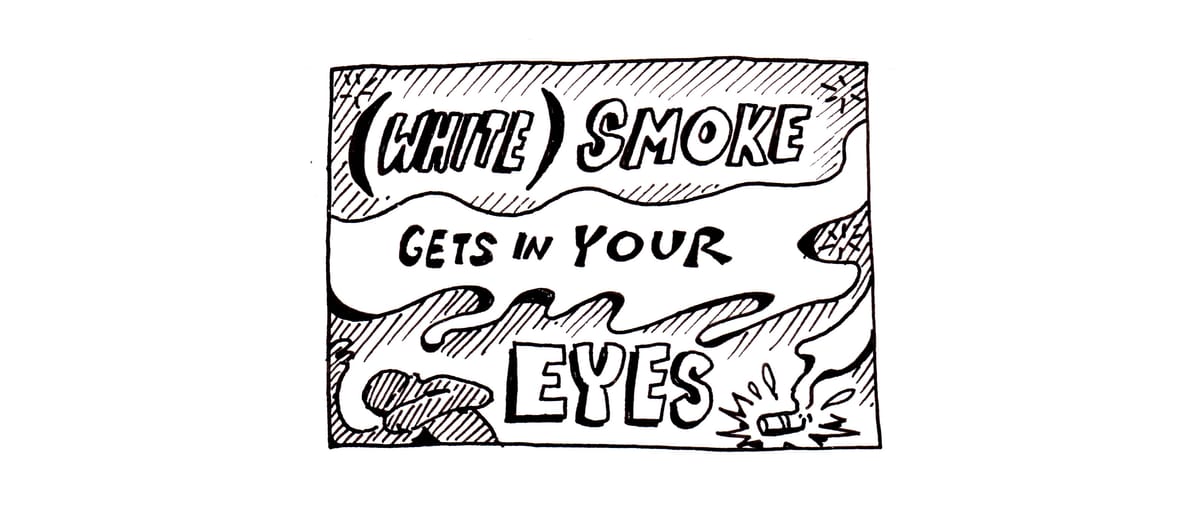
(White) Smoke Gets In Your Eyes

On whiteness, tear gas, and the need for non-linear history.
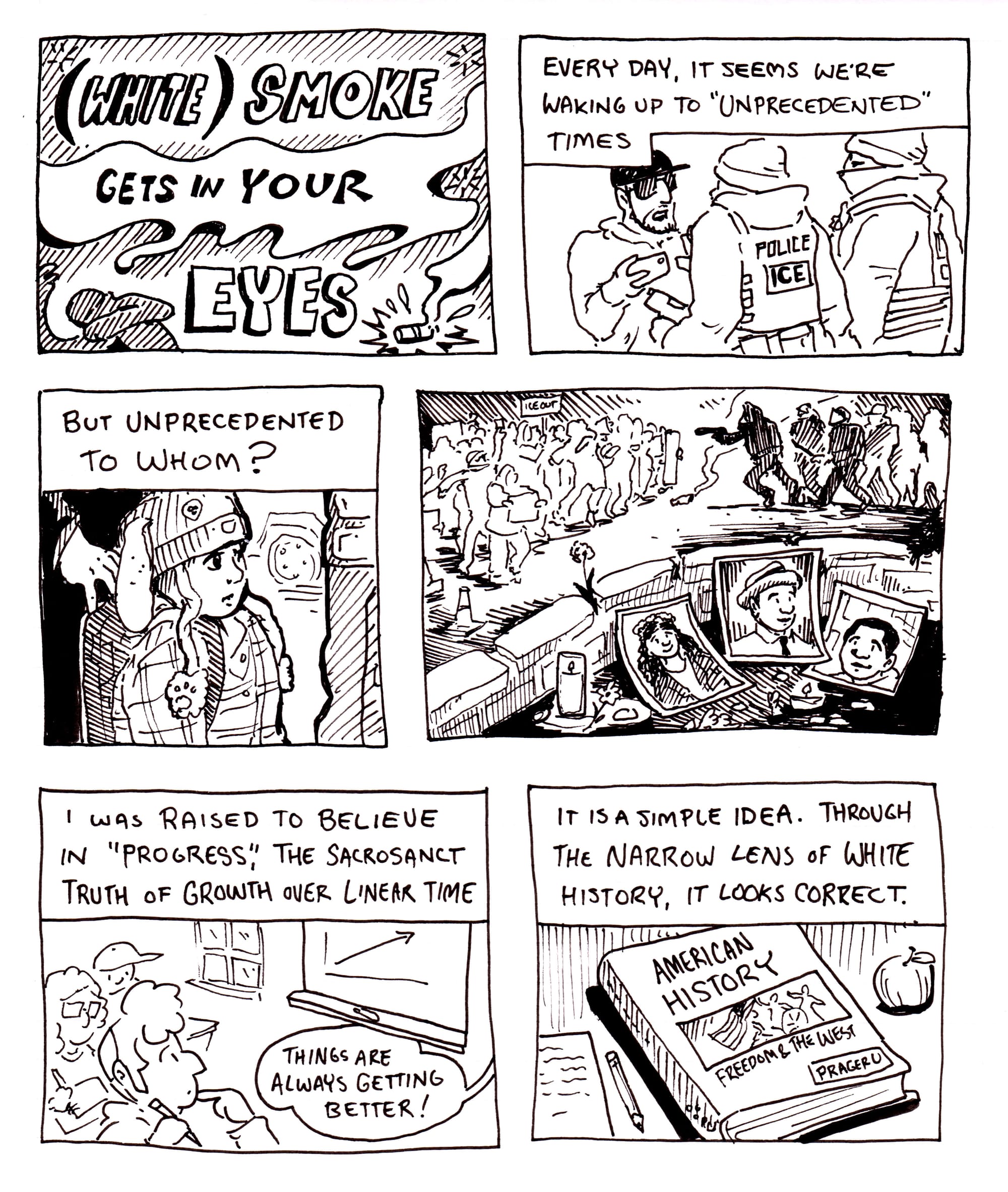
So many white people in this political moment seem absolutely blindsided by the magnitude of the state's brutality, especially ICE's invasion of the Twin Cities. I am watching, real time, as white peers and adults many years older are beginning to see something evil and true—but in absence of a robust anti-racist education, they lack useful frameworks or historical context for the state-sponsored terror unfolding across the United States.
Last Sunday, I had a call with a former high school teacher of mine, Corey Winchester. A brilliant Black educator, Corey is now working on his PhD researching the outcomes and pedagogy of a club he helped create at my high school called "Students Organized Against Racism" or SOAR, for short. The club hosted bi-annual peer-led conferences that processed students' experiences of race and racism, and taught me critical skills in identifying power structures and tenets of anti-racist organizing. I had the honor of serving on the SOAR board my senior year of high school, the year after the club first started. I was elated when I saw Corey had gotten in touch to interview me for his research project, nearly three hundred student board-members later.
As a young white kid, SOAR gave me a crucial education: It taught me to ask whose story was missing from the textbook and why. It taught me to stop denying the racialized cruelty that my friends of color faced everyday. It contextualized the fucked up world I was born into, delving into questions that few, if any, white adults around me seemed to be able to answer for honestly.
Corey and I spoke for three hours. It was the first time since college that I really reflected on the long-term impacts of SOAR, this remarkable—and as I'd learn after high school graduation, distressingly unique—education I'd received as a teenager.
My Black and Brown teachers prepared me to meet this moment: their teachings are among the greatest gifts I have ever received. However, it is haunting to see the confusion and fear arising in other white people who did not receive this education, and the white smoke that obscures, narrows, and disorients the real histories that can help us understand what's happening right now.
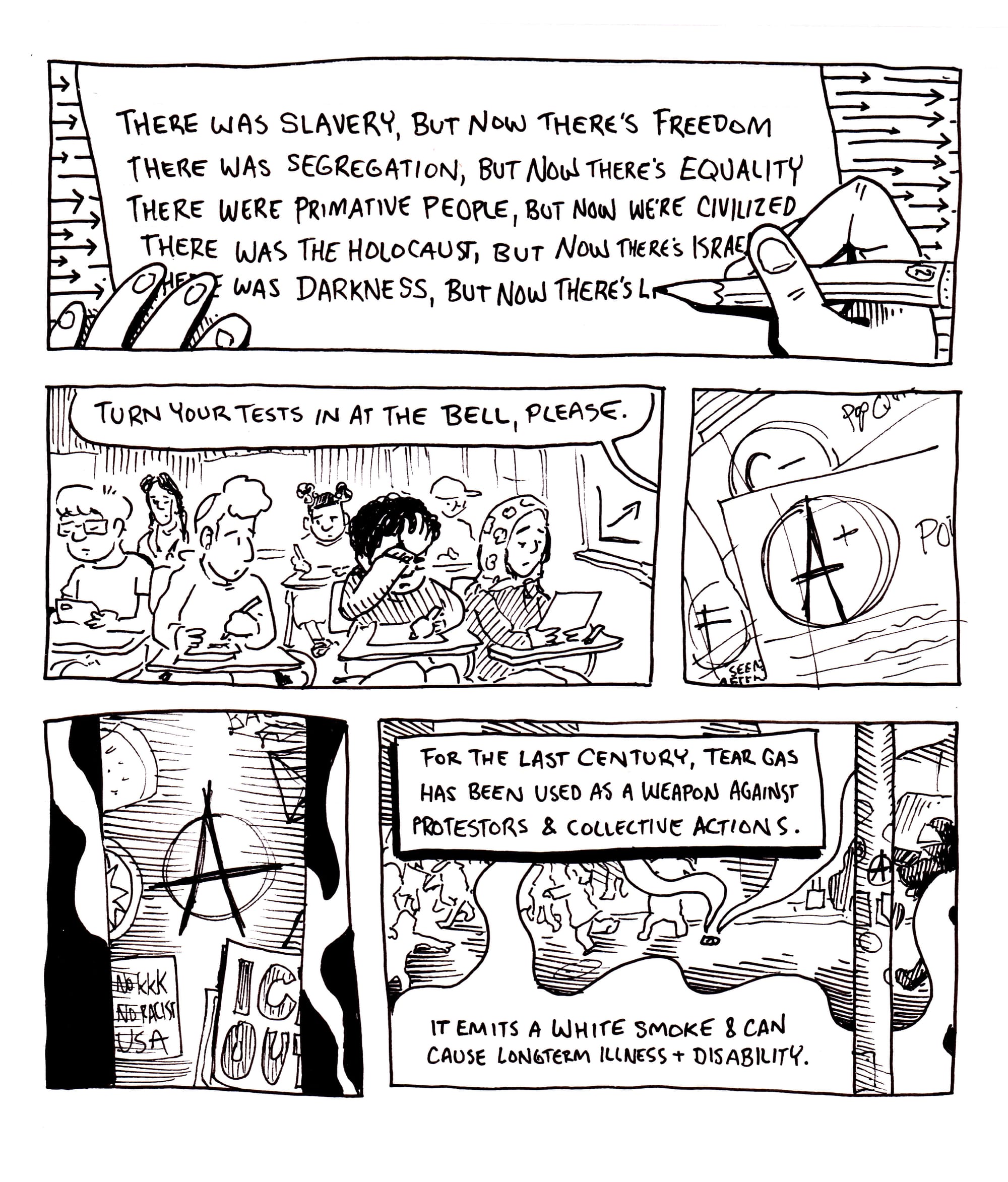
Dominant Western history narratives make this moment in time seem like an anomaly, a mistake. If you've been raised to believe that history is an upward linear march towards enlightened, civilized progress (or the more liberal version, the world is becoming inevitably more peaceful and just), then it seems incomprehensible how and why this scale of violence is erupting out of our hallowed halls of power. I have watched progressive white people look around with fear and outrage driven by confusion: this isn't the world that they were promised. Trump's presidency is an aberration. How can it possibly be getting worse? Why have these racist, abhorrent elements appeared so clearly in the present?
When you've been taught to see the present as the shining product of a tarnished past, the evils of today are severed from any continuity. In this understanding, yesterday's horrors can only be conceived of as a bygone boogeyman rather than a pernicious and ongoing reality. So when they persist, the story breaks.
By a linear progress narrative, major upheavals and movements for civil rights belong in the past. According to most U.S. History textbooks (and "The End of History"), today's liberal Democracy is the glimmering end of the story because the greatest evils are behind us. A bad thing happened, but now the better thing has repaired it. By reducing historical thinking into a children's happily-ever-after, fully grown adults are systematically deprived of the ability to understand how the past has come to bear on the present.
When James Baldwin describes how white boys never truly grow up to become men, he is describing, in part, how this historical naivete yields stunted human beings who cause catastrophic consequences for everyone else.
White supremacy relies on white people believing lies about others and themselves. If the horrors belong in history books instead of also existing in the present, whiteness can keep white people shocked, paralyzed, and helpless whenever they cannot avoid seeing that the past did not go anywhere.
This is intentional, and very advantageous to folks like Peter Thiel, Elon Musk, Steve Bannon, Tucker Carlson, and all today's other sinister powerbrokers and grifters: As long as white people remain shocked or confused by the world around us, the less power all our movements have to build a world free of racial and material exploitation.
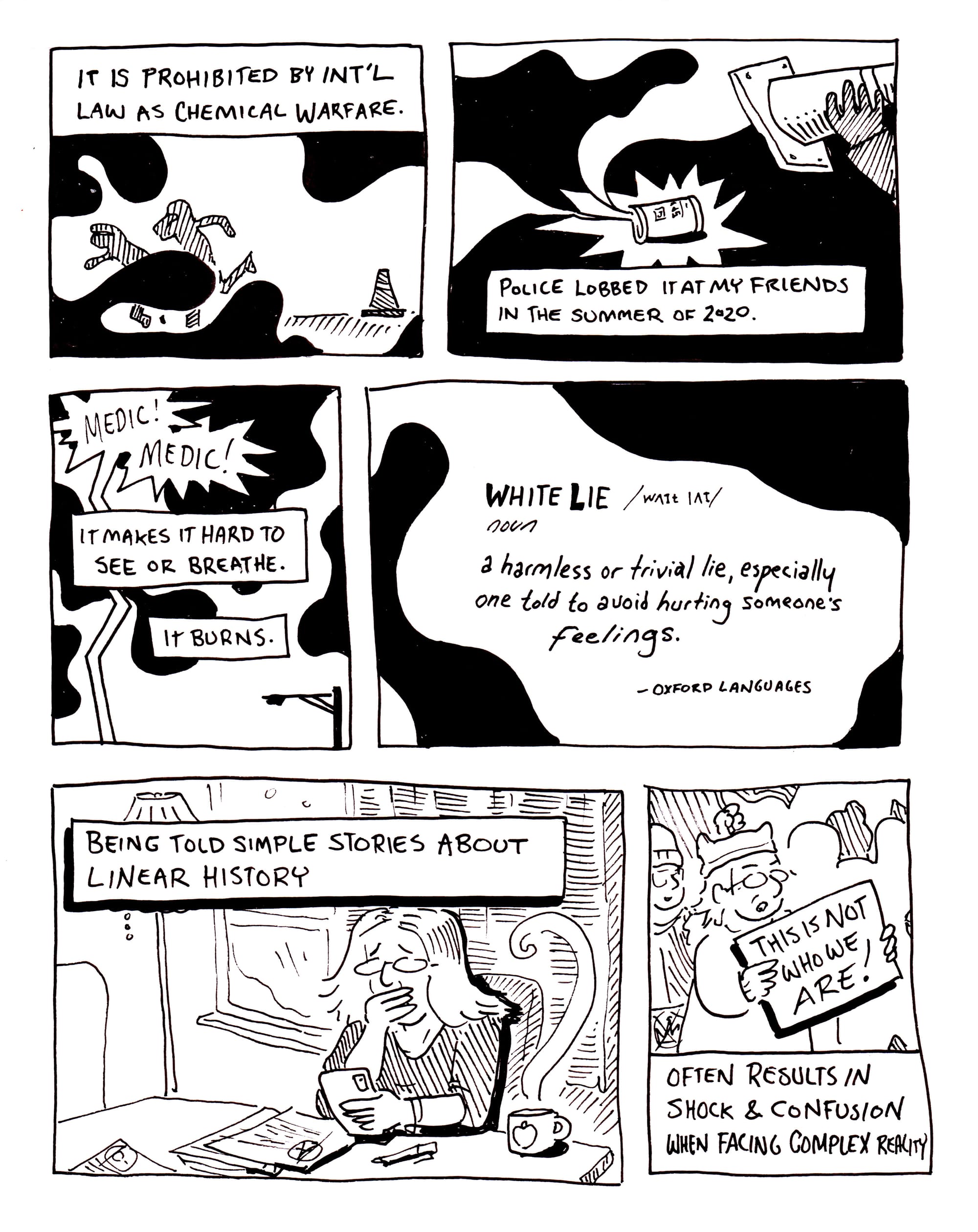
Like a tear gas canister, this white smoke gets in the way of understanding how the old, foundational events of America's past are violently, visibly exploding in the present. None of these events are new or unprecedented—the only thing that has changed is that whiteness does not guarantee a shield.
As lovingly as possible, I wanted to write this comix-essay not only for those who are witnessing white confusion, but for those who may be experiencing that confusion themselves. There is comfort to be found in knowing there are many others before us who have faced the enormity of this dying world's grief. They have seen it in previous decades, from angles that I have not. What they saw did not vanish into history; it has rolled into today. They have seen the same thing you are beginning to see now, in a different place, in a different time, and usually, in a different racialized, abled, or gendered body.
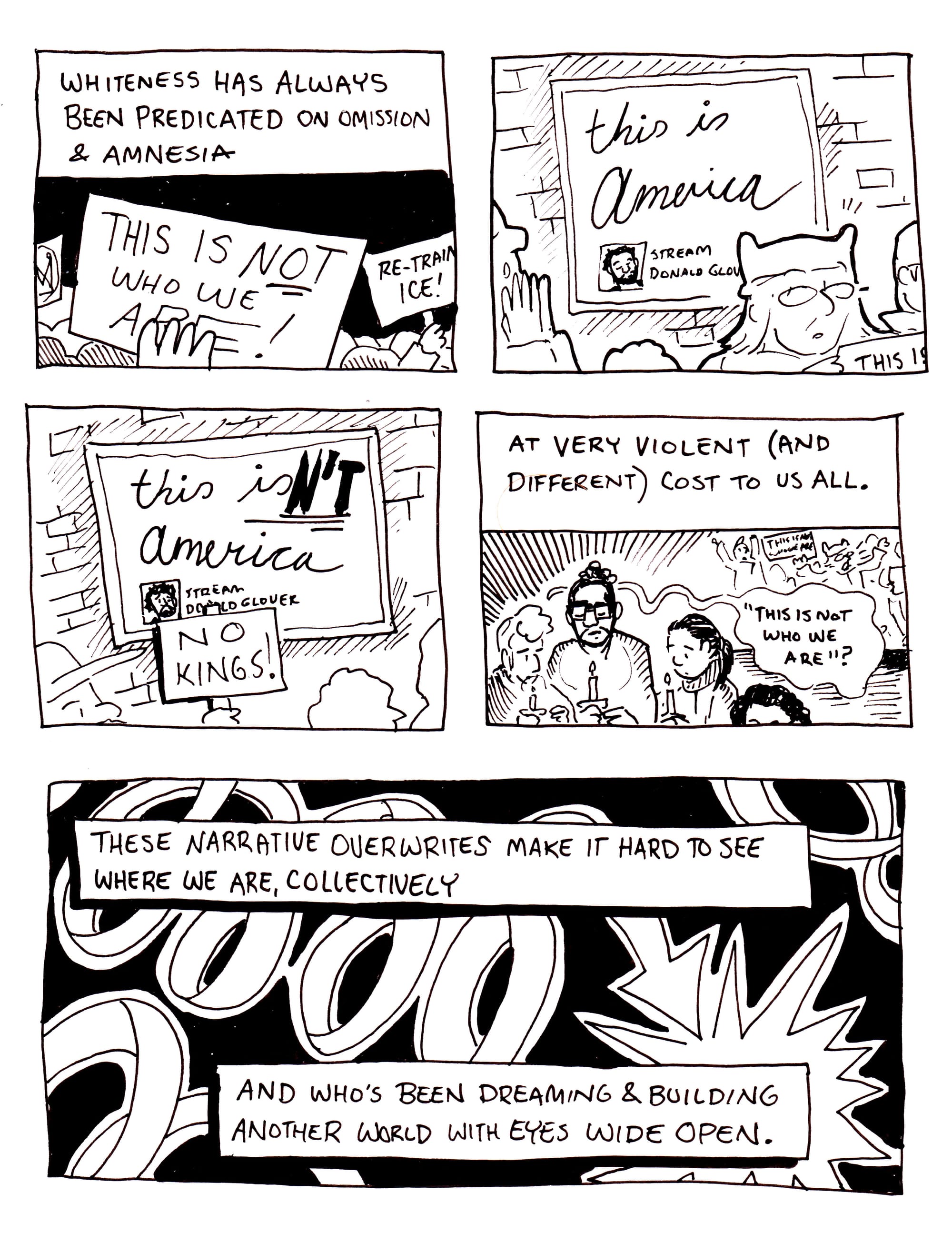
Ida B. Wells saw the lynchings of a Jim Crow south and documented how white vigilante militia mobs killed Black people for sport, debunking the myth that lynching victims themselves were already guilty of crimes. Hannah Arendt analyzed how policies of legal discrimination led to deportation led to fascism, answering how "just following orders" became genocide. Angela Davis traced the links between slavery, racism, and today's prison industrial complex, illuminating the past-present-future dangers of a police state where anyone can be disappeared into a cage and their freedom indefinitely taken away.
These are three examples of historical authors who pull today's threads directly. These writers are my teachers, who have seen the tapestry for longer than I've been alive. It is from these sources I can understand the following context:
(1) ICE agents are evolved from slave-catchers, part of a lineage of increasingly militarized police—we need not first look to Nazi Germany to understand our homegrown evils.
(2) A country built on stolen land projects the false premise of "legal" and "illegal" people. This yields an obsessive, violent exercise in trying to determine who belongs, using mass deportation as a tool of purifying its population.
(3) When people are abducted without trial, ICE facilities highlight how for over a century, police have abducted Black and Brown Americans for "petty crimes" or less, and disappeared them to prisons for life sentences under a punitive guise of so-called justice. What many white people are now seeing is that if it can happen to someone else, it can happen to you.
I keep coming back to an image of armed men in soldiers' uniforms standing in an unspecified living room. There is a coffee table, a baby bassinet, a television, a bottle of cleaning spray, a TV with too many cables, a raincoat hanging from the back of a door. It is a placeless image. It could be anywhere. Is it a living room with IDF soldiers in Gaza? Or American troops in Afganistan or Iraq? Without the caption, I would not have known that it was a living room in Minneapolis, Minnesota, not twenty minutes from where my grandparents used to live. When we understand how history becomes the present, it no longer feels like a reach to say that this isn't just an eerie coincidence: this type of invasive military violence anywhere can and will become a tool for repression everywhere, including your home and mine.
ICE did not appear out of nowhere, though hasn't been around very long. The agency was established in 2003, in the xenophobic national security backlash of 9/11 during the early days of the War in Afghanistan. ICE launched the same month as the US's first invasion into Iraq. When I think of that living room image, it suddenly doesn't feel like hyperbole to say that the violence we exported overseas has boomeranged back home: Obama himself inherited this militarized deportation machine and continued to fund it heavily. Immigration activists labeled him the "Deporter in Chief", logging an estimated 313,000 non-judicial deportations over the course of his presidency. Unlike his successor, he just didn't say it out loud.
ICE is part of a long lineage of increasingly militarized police forces in the United States, usually ramping up after a domestic liberation movement (or any Black and Brown community) has gained momentum. Whether it's the 1921 Tulsa Bombing of Black Wall Street, the 1985 Philadelphia bombing of a Black Philedelphia neighborhood, or the yet-untold stories of what's coming next, today's moment has a lot of context. We can educate ourselves beyond terrified confusion and paralysis. Our movements need people who understand that context so we can save our imaginations for building a more liberated future—not relegating them to catastrophizing about dangerous realities that require pragmatism rather than fatalism.
Without making this entire essay an attempt to trace the historical roots of the fascists we see abducting children and killing our neighbors, I want to highlight how learning marginalized histories is both a balm and a necessity in understanding how we got here—and even more importantly, freeing us up so we can figure out where we're going next. It'll give us clearer eyes to see what's already there and expand upon it: when we look at what neighbors in Minneapolis are doing to protect each other, we can see that good future is currently being built.
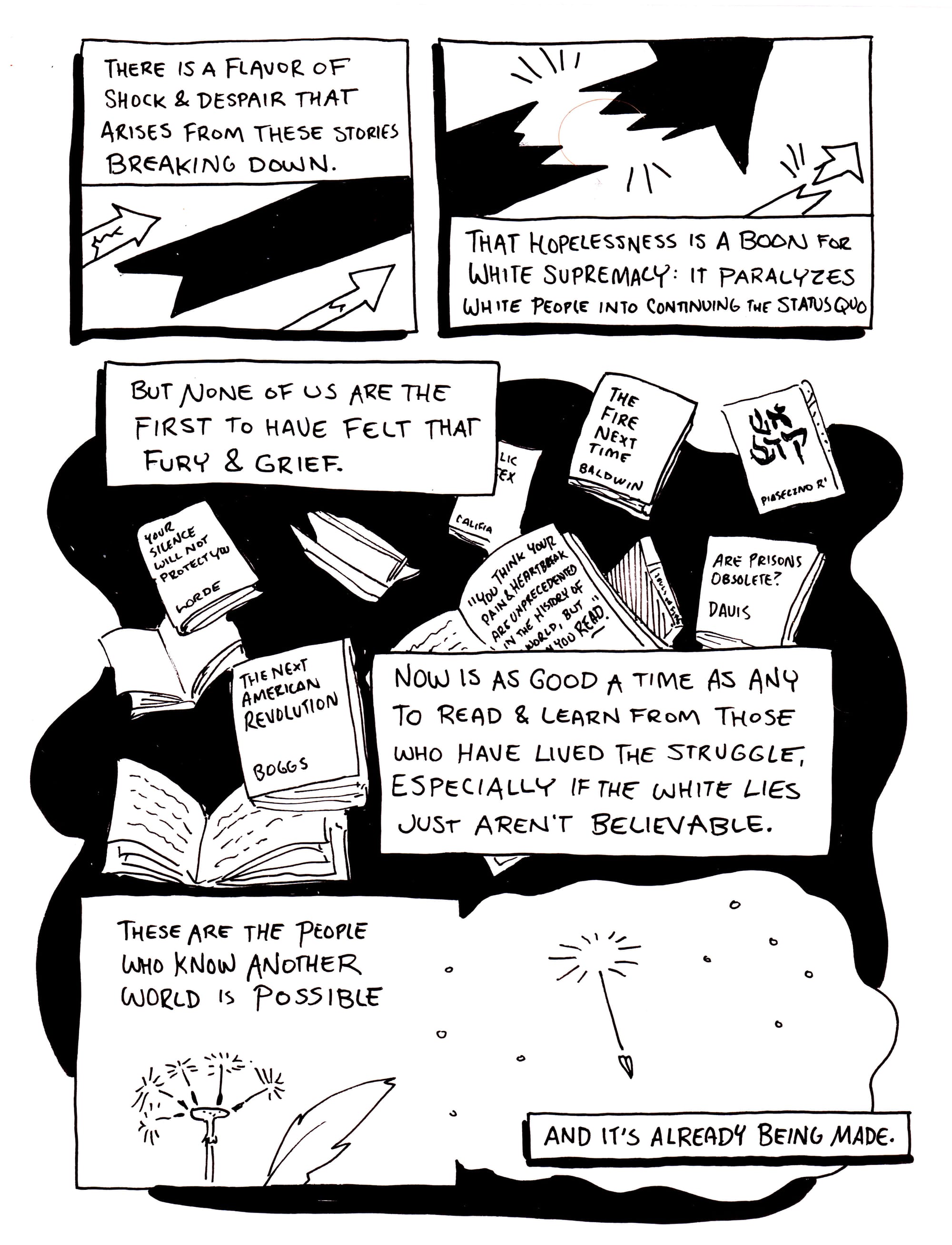
Today is the second anniversary of the murder of Hind Rajab, a five year old Gazan girl who, along with her whole family, was killed after IDF soldiers fired 335 bullets into their car. Today is also the day that news outlets reported that the 5-year-old Liam Conejo Ramos, the boy in the blue bunny hat taken into ICE custody earlier this week, is now very ill and held in detention, crying for his mother. This time next month, we will be observing the murder of Trayvon Martin. These are all our children.
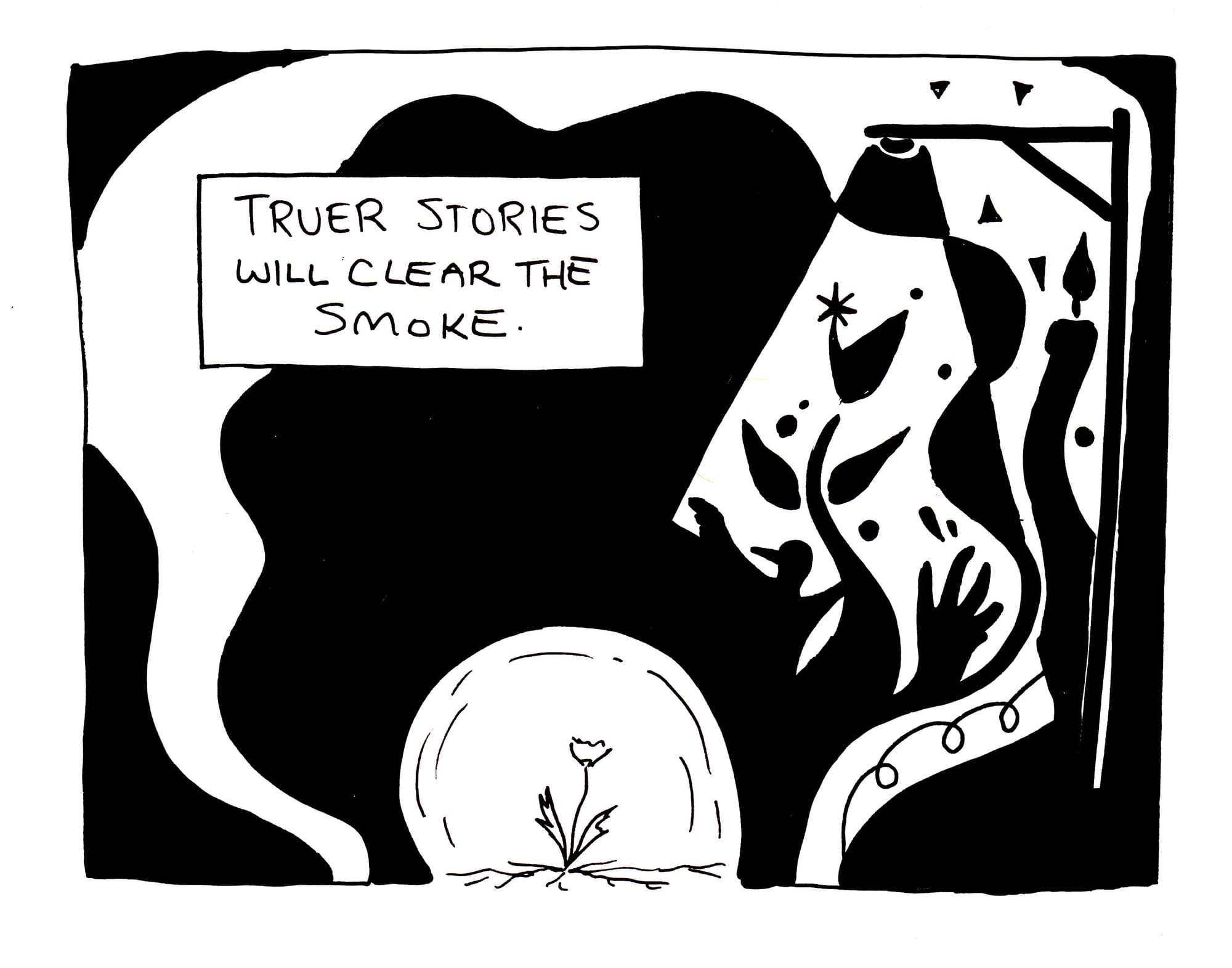
A country that cannot draw the line on genocide overseas will inevitably treat children within its own borders with echoed cruelty. So too, a country that genocides its native peoples and has not done teshuva will not be able to draw the line at genocide overseas. Which came first, the evil within or the evil exercised outside? We cannot deny that this is a core truth of America. Understanding non-linear history gives all of us a fighting chance at seeing ourselves as part of the mesorah, the tradition, of ongoing struggle against g-dless cruelty and towards olam haboh, the world to come. Truer stories innoculate us with the knowledge that none of us are alone in building a future that refuses abject cruelty.
As a Jew, I cannot accept a linear understanding of time. It is too simple; it denies the reality and complexity of Hashem's world. In order to survive dire circumstances, Jews and other victims of state violence have had to adopt different ways of seeing the past, present, and future. I choose Walter Benjamin's vision:
The tradition of the oppressed teaches us that the “emergency situation” in which we live is the rule. We must arrive at a concept of history which corresponds to this. Then it will become clear that the task before us is the introduction of a real state of emergency; and our position in the struggle against Fascism will thereby improve...the astonishment that the things we are experiencing in the 20th century are “still” possible is by no means philosophical. It is not the beginning of knowledge, unless it would be the knowledge that the conception of history on which it rests is untenable.
We can create knowledge that serves us in these ongoing crises, Benjamin writes. There is Torah here, we do not have to believe that we are resourceless, alone, or the collateral of a so-called 'linear' time imposed upon us by those who demand we stay unfree.
We can tell another story.
Surely the time of the soothsayers, who divined what lay hidden in the lap of the future, was experienced neither as homogenous nor as empty. Whoever keeps this in mind will perhaps have an idea of how past time was experienced as remembrance: namely, just the same way. It is well-known that the Jews were forbidden to look into the future. The Torah and the prayers instructed them, by contrast, in remembrance. This disenchanted those who fell prey to the future, who sought advice from the soothsayers. For that reason the future did not, however, turn into a homogenous and empty time for the Jews. For in it every second was the narrow gate, through which the Messiah could enter.
Time is a spiral. We can remember, and in doing so, remember who we want to be. We can remember our neshamas, our souls, our connection to G-d. We can remember that the future is not fixed because we know that there was and is currently a world worth saving. We live inside the uncertainty. We go back again and again to go forward. The power rests in our hands to bring mashiach, if only we treat every second as redemption's narrow gate.
If you're looking for ways to provide material support to those effected by the ICE raids in Minnesota, you can give tzedakah to the following:
- A friend's neighbor is in need of funds for his son's emergency surgery. He has lost wages due to the ICE raids, and the community is raising $2000 on his behalf. You can donate via venmo to @sheli-stein-69.
- Rosa, a devoted mother, has been abducted by ICE this month and separated from her three children. This fundraiser supports her kids and family legal fees.
- Hiluf, an asylum seeker, was recently detained by ICE. This fundraiser supports his legal fees and family.
Thanks for visiting my newsletter. Your readership, feedback, and support means the world to me. Thanks for being here. If you'd like to subscribe, it's always free—but if financially supporting me as an artist is feasible and matters to you, you can subscribe to my newsletter for just $5/month or send a one-time donation here.