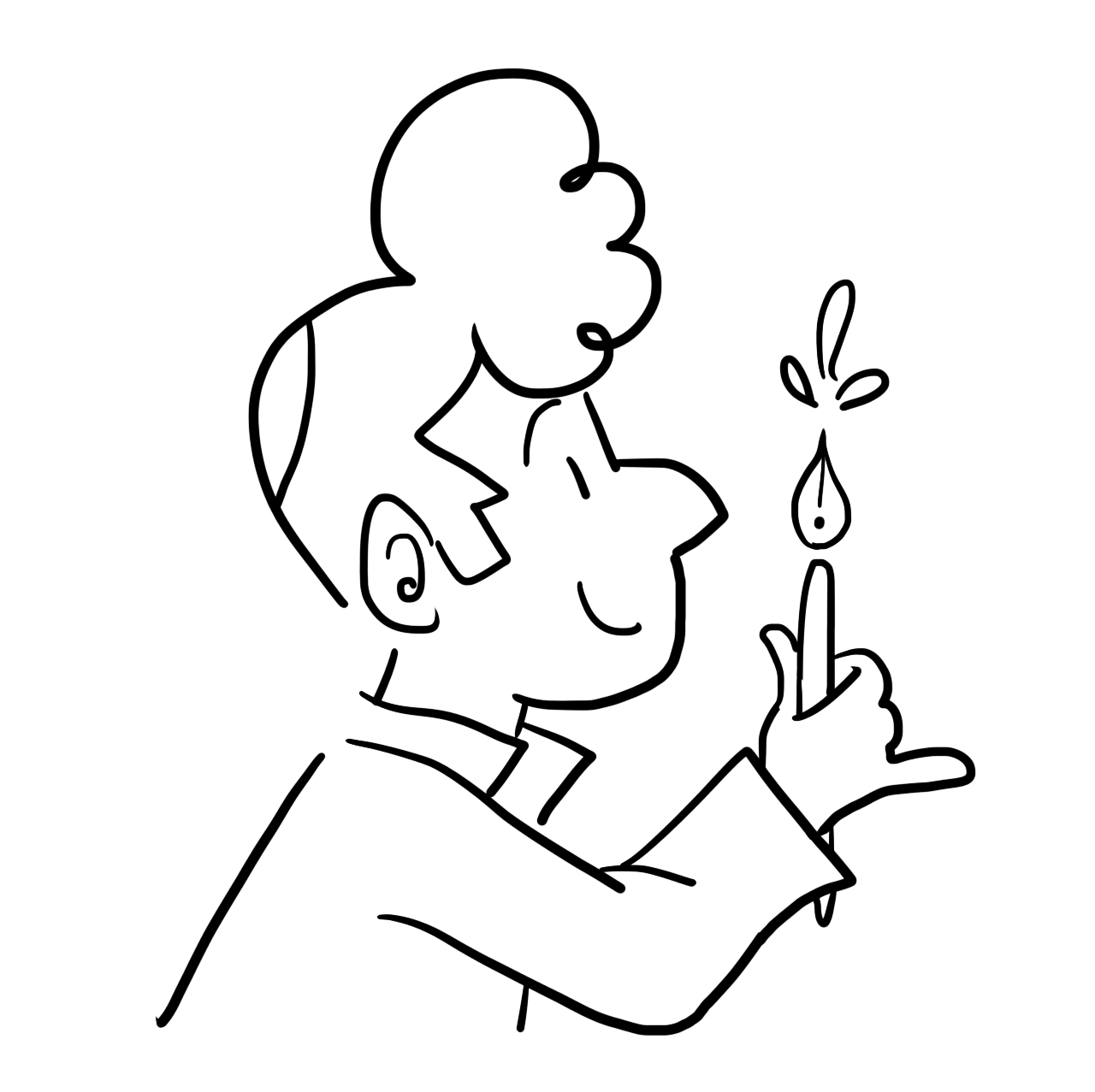
A Eulogy for Julian
Two weeks ago, my brother died by suicide. What followed has been the holiest experience of my life, inside of the most devastating.
Preface
August 12th, 2026 / 29th Av, 5786
In the five days between Julian leaving and his burial, I began the process of hesped, eulogizing my older brother. It was both the hardest and most intuitive task I have ever done.
Jewish time divides the period of immediate grief into two stages: aneinut and aveilut. These phases are separated by the process of burial. Levaya, which is often translated as "accompaniment" or "escorting," is the dividing line between one experience of mourning and the next. Living inside of it, these phases could not be more different, and the spiritual understanding of their gifts has been life-changing. Grief is dynamic. There is nothing like it.
I am now in shloshim, the thirty days that follow burial. Today is the first day I have been able to write in any public fashion. I feel there will be more testimony in weeks to come, as I begin the lifelong marathon of mourning the death of my brother. Today is the first day I feel both able and desiring of sharing this process with the world beyond my immediate circles.
I have things to say, but cannot do so yet: whether about the truly sacred time I spent with my brother after his passing, or the remarkable digital shiva group that has accompanied me through the deepest parts of this transition between a life where my brother is alive and a world in which he is not, I am embarking on the long, slow process of sorting through and giving over some of what I've experienced, for my own sake first, and secondarily as a chizzuk, a strengthening, for those who already or may someday have similar encounters. This is a way to nurture and disperse the spiritual seeds that my brother sowed in my life. The echoes comfort me. Silence comforts me too, in turns. I will take my time, for perhaps the first time in my young life. There are moments from this period that will remain wordless and private. These things will occur to me as they arise; I am in no hurry. Today, I wish to be witnessed.
My brother was, among many things, an amateur gardener — this spring was his first season. My husband and I had bought him a set of seeds, as a gift which we hoped would be therapeutic and rewarding, as well as a way to stay in touch, since we garden together ourselves. I taught him what my husband taught me, and over Pesach we sowed seeds, built raised beds in the yard, and planted out a couple of sprouts. He did the rest. We sent pictures across the Atlantic in a Whatsapp group we called "Gardening Bros".
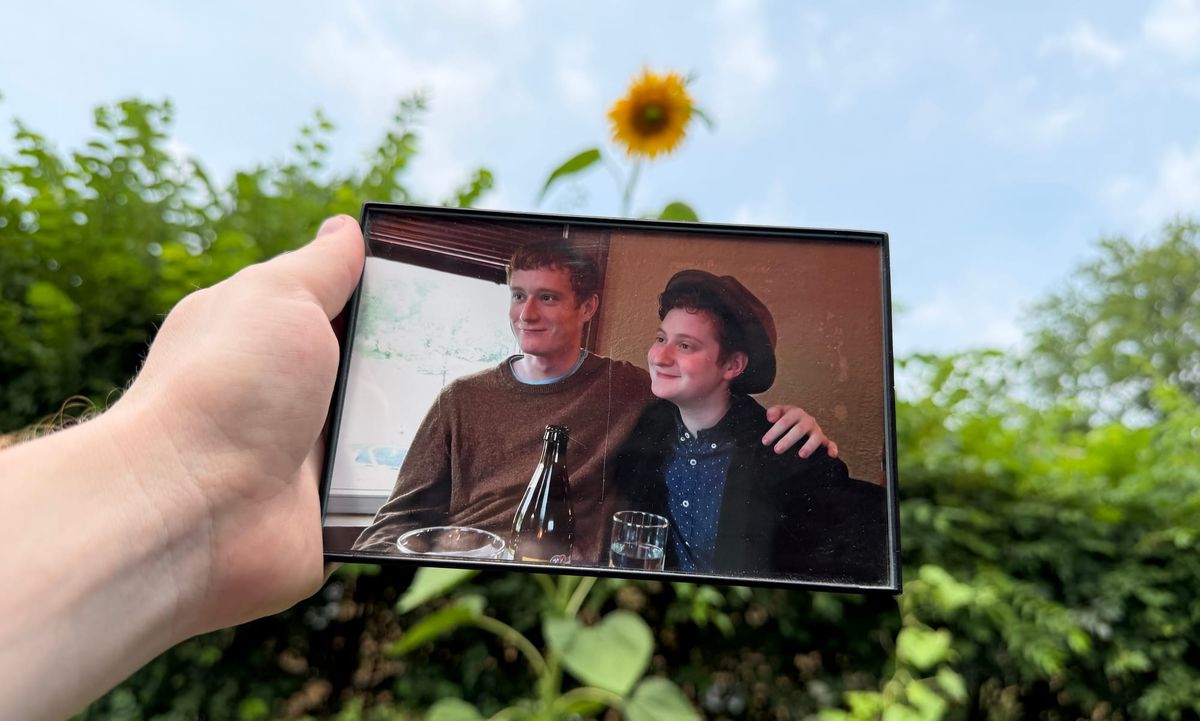
In these weeks we've enjoyed his Mideast Peace cucumbers (a name he delighted in), and the Santiam Sunrise tomatoes that began to ripen after his departure. The kitchen overlooks his garden, as the peppers grow and the calendula blossoms, dies back, and blossoms again. But most significantly, the day that he left, the flowerhead of a ten-foot tall sunflower — the sole surviving sunflower — emerged. The day that shiva ended, its yellow face was in full bloom.
It is strange that my last essay was about the door of grief, and how I struggled to break open for T'sha b'Av this year, exactly a week before Julian's departure. Now, in his terrible absence, at both the request of many friends and out of a desire to share his life and memory, I am sharing my hesped, my eulogy, for my brother, whom I love as I love myself, whom I carry with me always. The full service is here, with my eulogy at 23:46.
Plant seeds in Julian's honor; give the rest to your friends. Play some chess. Teach someone a new skill, a new word. Learn a different language, speak it with strangers. Admire a corgi. Tell someone a joke, share a meme, laugh together.
My brother wanted his life to create more life, so too my own. Join me in celebrating him. This is how we build a world in which he too could've further flourished, one we all deserve.
Eulogy for Julian
August 4th 2026 / 17th Av 5786
My name is Rena Yehuda, I am Julian’s younger sibling. Before I begin, I would like everyone to turn to the person next to them and tell them, “What is one thing you’ve chosen for yourself?”
____
Thank you for sharing of yourself this way. These moments where we can do so are holy, and are part of tending and healing the brokenness of the world. And this is a moment of holiness and brokenness.
Every gift I have is for and from Julian. And in our shared gifts, we have both appreciated our choices, our freedom, and ourselves.
My brother and I are made of the same material. Our faces rhyme, and so does our avodah, our holy work in this world. Before we were born, or perhaps at the moment we decided to be together as siblings, as sister-and-brother, brothers in this life, and choose our parents as our parents and our family as our family, we agreed to be each others’ allies – companions in accomplishing what we were put here to do. We lived in contrasts and parallels, devoted to the knowledge of the brokenness and possibility of the world, and the role that love and freedom play in bringing the next one.
And so we were born into these lives, feeling like strangers, and deriving different tools to achieve the same holy end: exploring olam hazeh, the world as it is, for ways to bring olam haboh, the world to come.
Our Hebrew names, too, are emanations of our shared understanding. Our double-barrel names were given wisely to us by our parents: My name, Rena Yehuda: Rena being joyful song, Yehuda being a Jew, one who is grateful, or contains the divine aspect of Hod. So, I am Rena Yehuda, joyful Jewish song, perhaps joyful song of gratitude. His name, Chayyim Yitzchak: Chayyim, life, plural, in the way that water is plural, and endless. Yitzchak, he who laughs, causes laughter, laughter itself. So, he is Chayyim Yitzchak: a life – or lives – of laughter. Or, perhaps, the laughter of life. We dance together as song and laughter, in the gratitude of being alive. Chayyim Yitzchak and Rena Yehuda: The Laughter of Life and Joyful Jewish Song.
The best part about a funeral is being together. And the best part of being together, in my experience, is witnessing one another, and telling stories.
When we were little, we played with marbles---building stadiums out of Lego duplos for marble wrestling competitions. He would create brackets and meticulously list the wins and losses. I elaborated complex relational plotlines for the emotional fallout of these championship competitions. We had our rituals and games. Being my older brother, I followed his lead as we embarked treacherously into the early 2000s internet, a place of freedom and peril. He revealed to me unexpected frontiers for freedom – message boards, forums, Runescape. We both learned to type this way, the first inklings of lives which would use language as our vehicle for connection with others---and he would go on to become a polyglot of many tongues. At the console in the dining room we discovered that language would grant us our earliest experiences of a freedom we relished both separately and together.
True to his Hebrew name, Julian evolved a distinct and niche sense of humor deeply connected to the idiosyncrasy of our digital time, and I absorbed its subtlety and joy at the absurd. Humor was everywhere in our lives together, indelibly intertwined with the alienation we both felt at a cultural context that couldn’t quite make sense of either of us. It was through laughter that he alchemized the way he felt like a stranger in a strange land, and in doing so, illuminated the way for me to know that when I too faced struggle, alchemy was always an option. Because I had him, and he loved me, I knew I was not alone in feeling alone.
He is escorting me now, as I become a steward for him. I will share with you my heartache – not because there is a single thing about him that is tragic, but because the nature of his struggle illuminates a mechanism that is so endlessly beautiful, not only about him, but about the nature of everyone I love because of him, and the nature of redemption itself.
When Julian was in his sophomore year of college, he experienced his first significant mental health episode. In the time that followed, he and I had to be more distant from one another. We would call or text, but it was sporadic, with long spaces in between. It was very hard for us both. Being inside of that distance was a practice in the endurance of faith: to learn that distance is actually a tool of holiness, and that one definition of kedusha, of holiness, is separation and setting things apart. It is distance between logs that allows oxygen to enter and the fire to flourish. It is space between plants that allows their roots to spread as wide or deep as they need, so that growth can find its form. These processes can be tended to, but never controlled. He let me go and accepted my own search for myself, far away. For a decade, we were apart, and refined the practice of emuna, of trust: leaving a light on for someone after it’s gotten dark.
I never lost hope of him. It wasn’t that I believed that one day he would find his way, but that even in our separation, he was actively wayfinding. It is from him that I learned how to have enough faith in someone that they are strengthened enough to produce it for themselves.
In the long decade of our apartness, I turned to Torah to find him. He was numbed to the world in order to cope with what he hadn’t yet acquired spiritual tools for, and so I forgot his first Hebrew name in the same year I acquired my second one. In the amnesiac meantime, I held on to the patriarch of his second name. Yitzchak Avinu, Isaac of the Tanakh, wanders across the world digging out the wells his father built, which have been filled in and no longer give water. Yitzchak’s experience of the Akeidah, the binding of Isaac, left him with traumatic knowledge of the world’s terrible paradox. But instead of forfeiting to grief, Yitzchak quietly and devotedly digs wells and brings forth water, so that vitality may be restored to everyone. He makes the world more livable, not just for one person, but all of us, in a way that sustains generations.
Even when he was far from me, I watched Julian do exactly this. He learned and mastered Russian language before moving on to Spanish, Japanese, and certainly other languages he hadn’t yet told me about, became an excellent chess player, and traveled the world to see what else was possible. Like me, he desired and led an international life. So he completed a Masters in International Relations to channel his hard-won skills into bettering the world through service. It is through no fault of his that there was no government to employ him after his training. The systems of the world could not hold him.
This past Passover, in this terrible political time, I came home and saw him in person for the first time in a year and a half. But this time, for the first time in so many years, he was there, really present and there, in a totally new way. And so we met, for the first time, as adults, with delight. Finally, after years of a wall, a wash, an overlay, we were together in full color.
Like our great grandfather Hymie, my husband Ed is a master gardener --- or will be very soon. Julian and Ed felt a deep love for each other immediately, and so when I was coming home for Pesach, we decided that we would send him seeds as a gift. The seeds arrived when I arrived, and Julian and I began to garden upon my arrival. I loved that he wanted to, that he was excited for it, to try it. We took recycled Chinese takeaway trays and sowed beans, peas, cucumbers, tomatoes, pollinator party wildflowers, and sunflowers. I taught him what I learned from Ed, built raised beds in the yard, and watched the seedlings grow over the week I was there.
When I returned back to the UK, every time Ed and I went to our garden, we sent him photos and he returned the favor. Things grew. The metaphors were straightforward and life-affirming. The plants themselves were lovely. Our conversations flourished. We began to speak on the phone every week, a few times a week. We learned how to have short phone calls alongside the long ones. We talked about everything, including how awful the world was, and then forged frameworks for understanding its redemption instead of giving into the fatalism that our oligarchs encourage. Over those months, the tallest sunflower grew in our backyard. As he said goodbye, we were also saying hello.
The last five days since he left have been some of the most sacred of my life. This liminal time, between exit and burial, is precious and has been filled with tremendous aliveness and revelation. I have slept very little and feel like Jacob the night of his dream: with angels running and returning, how could I sleep in such a holy place? I have experienced the pluralness of the name Chayyim Yitzchak, as my life is enlivened by his, his life absorbed into mine. It has been a tremendous Shabbat: he is my double portion, and I have had the profound experience of having two lives inside of one. With him near me, in me, and with me I feel strength and protection and joy, joy, joy.
Not a single thing about Julian was tragic. He lived his life with a full force that is a mirror image of mine. His choice to take his life is a testament to how hard and strongly he chose life each day he lived it – consciously, powerfully, as an expression of will. He loved the world and the people who composed it in a way that was straightforward and direct, with a simplicity that is no simple task. He was unfailingly kind to other people, even when he felt alienated or perplexed by his own station. His profound sensitivity to presence allowed him to see both the magnificence of the world and its terrible limitations – and he found endless ways to work that paradox in service of life. He wanted things to change, always, and admired people who were courageous enough to become more themselves. Julian didn’t need to understand someone in order to love them, and in doing so, allowed others to be more fully themselves and therefore, more possible to be understood and loved better. He loved and admired me, and in spite of our endless sibling frustrations and arguments, he experienced me never as a rival and always as a talisman and companion, fighting with him in service of his becoming, completely in his corner, and proud to be in mine. What a spectacular way to be loved.
In missing my brother for a decade, I also sought him out everywhere. This meant that I found his gifts everywhere. Because I missed him, and because of the way we loved each other, I met the people who I now love most. I fell in love with my husband Ed especially because of my love for Julian. And in turn, Ed’s love for me and for Julian allowed me to love and better know my brother in the past four years. I wanted to build a future for us both, for us all, surrounded by people who saw me and loved me as I am, and so too could bring grouplove that would see and love Julian as he deserved to be seen, loved, understood, admired, and celebrated. Because of Julian, I now have many brothers and a whole family of people who I love, and strive to love well. They multiply his light like a chandelier. None of them can replace him.
As I wrote in my grief groupchat that is composed of many dear ones, which has itself become like a digital shiva, “I am having a very live realization that the love produced in a relationship between two people is a fusion of spirit. And while true in shared life, when one of them is gone, this fusion is best honored when it results in new relationships, and new love. My memory of Julian will forever be transformed by the remarkable connections that are happening here, now, in the wake of his passing.”
Today I am learning how to connect people to each other so that nobody is left behind. I hope that more of this happens today, as a result of us all being together, and witnessing one another, in our choices and our uniqueness. The time between his leaving and his burial has been an experience of living inside of the paradoxes that he himself saw clearly: the experience both of devastation and of olam haboh, of the world to come. This week I have seen friends and loved ones from every corner showing up with devotion, bringing what they have to hold me and each other in this loss---while creating something entirely beautiful, loving, and new with each other in the space of Julian’s absence. We leave the light on.
This too is the sourcecode for how to make a better world. It is how to dig wells. It is the mechanism by which we will transform this country into a place that is livable and beautiful. Julian was deeply concerned with the political state of affairs, with climate catastrophe and the rise of fascism. The lessons of connection that illuminate my life with him are, coincidentally, exactly the medicines we need in order to change it all for the better.
In this strange moment I see most clearly that the world Julian and I long for is possible. In this way, he has helped reveal its vision and build its reality. I didn’t want him to go yet. I didn’t want to be an only child. I don’t know what lies through the door this grief. I accept his decision.
Our love as siblings has allowed me to love the struggle in myself, which opens every door to love the struggle in others. Every single person I love is a gift from and for him.
Julian planted these great seeds of my life. As I take him with me into this totally unknown chapter, I will tend their growth and do my best to share the fruits of our shared labor. I hope you will find your own unique ways to do the same.
His life was and is in service of life. May we go from strength to strength, from life to life.
I love you, Julian.
It is customary to give tzedakah in honor of someone who has passed. In Julian's honor and as a comfort to me, please consider a monthly contribution to two anonymous giving circles I have organized for dear friends who are in need of financial support, who have emotionally supported me in this time. You can give here and here.
Thanks for visiting my newsletter. Your readership, feedback, and support means the world to me. If you'd like to subscribe, it's always free—but if financially supporting me as an artist is feasible and matters to you, you can subscribe to my newsletter for just $5/month or send a one-time donation here.